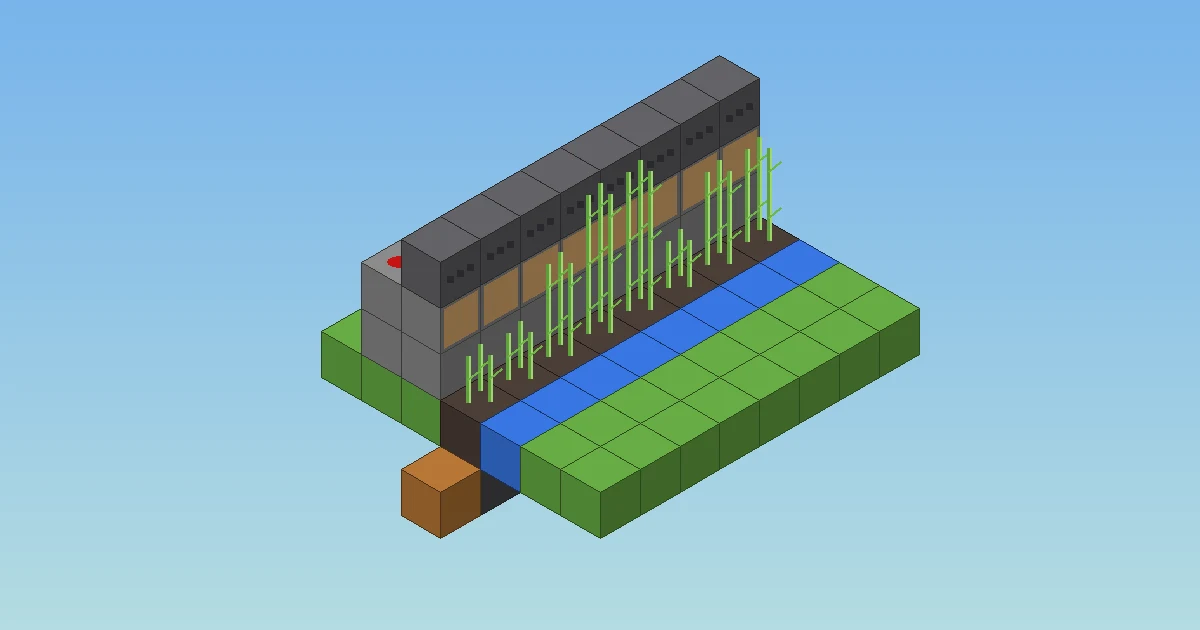
An automatic sugarcane farm uses an observer to watch each sugar cane plant and a piston to break the cane the moment it grows tall enough. The drops fall onto hoppers and slide into a chest, so you get a steady stack of cane without ever swinging your arm. You can build a working version in about 15 minutes with pistons, observers, redstone dust, hoppers and a bucket of water.
This automatic sugarcane farm design works in both Java Edition and Bedrock Edition on version 1.21 and later. Below you’ll find the block layout, materials, collection setup and the fixes for the mistakes that break most first builds.
Key Takeaways
- Every plant needs a piston at the height of the cane’s second block and an observer right above it.
- Sugar cane only grows next to water, so plan a water channel beside your planting row.
- Planting on mud lets hoppers underneath pick up the drops directly.
- On Java Edition, each plant gives roughly 3 cane per hour, so length matters more than clever wiring.
- The farm only runs while you’re nearby, so build it close to your base.
Why an Automatic Sugarcane Farm Is Worth Building
Sugar cane turns into paper, and paper quietly runs a lot of your survival world. You need it for books and bookshelves (enchanting), maps, firework rockets for elytra flight, and librarian trades. A novice librarian will usually buy 24 paper for one emerald, which makes cane one of the easiest emerald sources in the game.
Harvesting by hand gets old fast, though. An automatic sugarcane farm handles the boring part while you mine, build, or AFK nearby, and it’s one of the cheapest redstone farms in the game.
How Sugar Cane Grows (and Why the Design Works)
Three rules decide whether an automatic sugarcane farm works:
- Water must touch the base block. The block you plant on (dirt, grass, sand, red sand, podzol, moss or mud) needs water directly beside it on at least one side. Diagonal water doesn’t count.
- Cane stops at 3 blocks. Naturally planted cane grows up to three blocks tall and then waits.
- The bottom block regrows. If you break the second block, the first block stays and starts growing again. That’s the whole trick.
On Java Edition, sugar cane grows on random ticks, and one new block takes about 18 minutes on average. Growth is random, so don’t panic if a test plant sits still for a while. Bedrock Edition lets you use bone meal on sugar cane to grow it instantly, which is handy for testing your redstone.
Materials for an Observer Sugar Cane Farm
Here’s what an automatic sugarcane farm needs per plant. Multiply by the length of your row. A 16-plant row is a good first target, since redstone dust carries a signal 15 blocks.
| Item | Per Plant | Crafting Recipe |
|---|---|---|
| Sugar cane | 1 | Found near rivers, lakes and beaches |
| Piston | 1 | 3 planks, 4 cobblestone, 1 iron ingot, 1 redstone dust |
| Observer | 1 | 6 cobblestone, 2 redstone dust, 1 nether quartz |
| Redstone dust | 1 | Mined from redstone ore |
| Hopper | 1 | 5 iron ingots, 1 chest |
| Mud | 1 | Use a water bottle on dirt |
| Solid building blocks | 3 | Stone, cobblestone or any full block |
| Water bucket | 2 total | Bucket: 3 iron ingots |
| Chest | 1 or 2 total | 8 planks |
Nether quartz for the observers is the real bottleneck. Not in the Nether yet? Use the one-observer version below. Hoppers cost 80 iron for 16 plants, so plan for that too.
Step-by-Step: How to Build an Automatic Sugarcane Farm
Pick a flat spot near your base and lay out a straight line 16 blocks long. From back to front, your automatic sugarcane farm has four lines: redstone, pistons, the planting row, and water.
Step 1: Dig the Planting Row and Place Hoppers
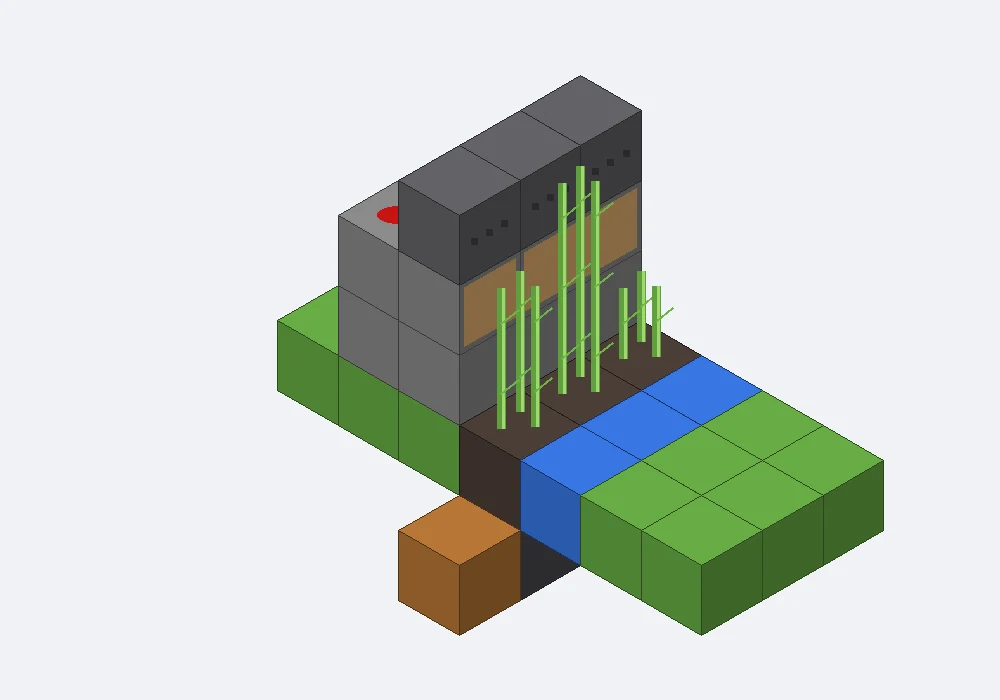
Dig a 16-block trench two blocks deep. Place a hopper at the bottom of each spot, chaining them so each one points into the next (sneak while placing to aim them). Point the last hopper into a chest at the end of the row.
Step 2: Plant on Mud Above the Hoppers
Put a mud block on top of every hopper, so the mud sits level with the ground. Mud is slightly shorter than a full block, and that small gap is what lets the hopper underneath grab items resting on top of it. Plant one sugar cane on each mud block.
Step 3: Add the Water Channel
Dig a one-block-deep channel right in front of the mud row and fill it with water. You only need two water buckets: place one at each end of a 3-block stretch to make an infinite source, then fill the rest. Every mud block should now touch water on its front side.
Step 4: Place the Pistons
Behind the cane, put one solid block on the ground in each spot. On top of each block, place a piston facing the cane. Each piston should sit level with the cane’s second block, not the first. If a piston hits the first block, it will break the whole plant.
Step 5: Place the Observers
Set an observer on top of every piston. The face (the side with the “face” texture) must look at the cane, and the red dot on the back should point away from it. This observer is watching the spot where the third block of cane will appear.
Step 6: Wire the Redstone
Behind each piston, stack two solid blocks so the top of the stack is level with the piston. Run redstone dust along the top of that line, so the dust sits directly behind the observers. When an observer sees cane reach block three, it pulses the dust, which powers the blocks underneath and fires the pistons.
Step 7: Test It
Wait for one plant to hit three blocks (or bone meal it on Bedrock). The pistons should punch out, and the drops should land on the mud and drain into the chest.
How the Hopper Collection System Works
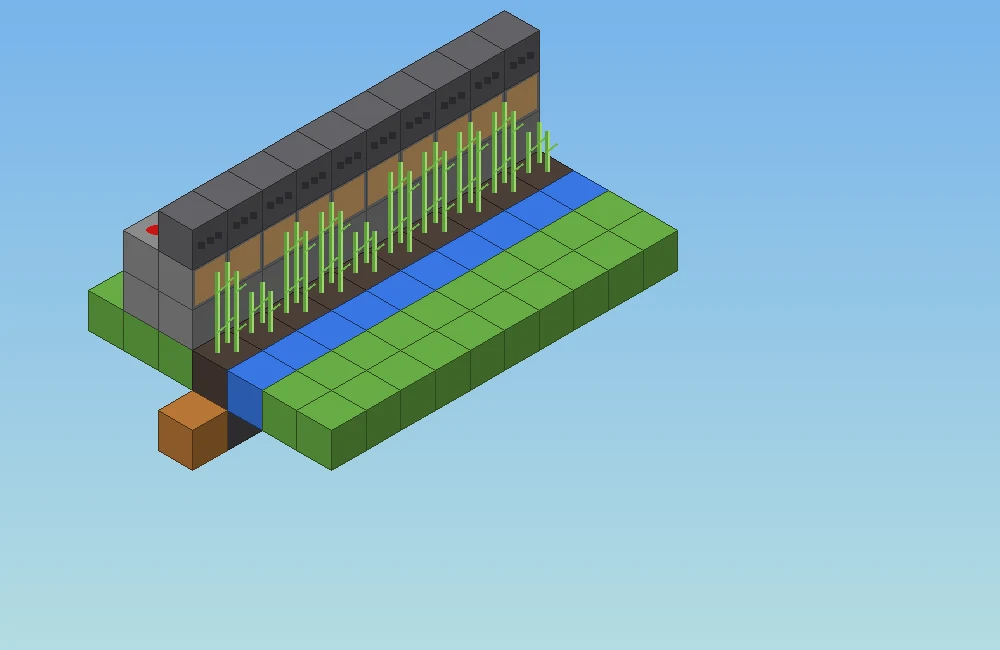
When the piston breaks the second block, both the second and third blocks drop as items. Most of them fall straight down through the remaining stalk and land on the mud. The hopper underneath pulls them in and passes them down the chain to your chest.
A few items bounce sideways into the water. Stop that with a wall of glass above the water channel, up to 3 blocks tall, so you can still watch the farm work.
A single chest holds 27 stacks, or 1,728 cane. If your automatic sugarcane farm has several rows, upgrade to a double chest.
Alternative: Hopper Minecarts
No mud? Plant on regular dirt and run hopper minecarts on a rail one block under the dirt. Hopper minecarts pull items through a full block above them, then unload into a hopper and chest at the end of the line.
Minecraft Sugarcane Farm Design Upgrades
Once the basic automatic sugarcane farm works, these changes boost output without much extra cost:
- Mirror the row. Build a second planting row on the other side of the water channel, facing the first. One water line feeds both rows, and you double your cane.
- Go wide, not fancy. An automatic sugarcane farm’s output scales with plant count. A 64-plant farm makes about 4 times what a 16-plant farm makes.
- Add a repeater for long rows. Past 15 blocks, the dust signal fades. Put a repeater in the line, or just give each section its own observer.
The Budget Version: One Observer per Row
If you’re short on nether quartz, use one observer for an entire row and let the redstone dust carry its signal to every piston. When the watched plant hits three blocks, every piston fires at once. Shorter plants get cut early, so you lose a little growth, but this cheap automatic sugarcane farm still works well. Swap in the full set of observers once you start mining quartz.
Automatic Sugarcane Farm Output and Tips
On Java Edition, expect roughly 3 sugar cane per plant per hour at default settings. A 16-plant row makes around 50 an hour, and a mirrored 32-plant build makes around 100. Growth is random, so expect swings from hour to hour.
Your farm only grows while its chunks are loaded, which means you need to stay within your simulation distance. An automatic sugarcane farm built 2,000 blocks from your base will basically never run. On multiplayer servers, a lowered simulation distance shrinks that area further.
Automatic Sugarcane Farm Problems and Fixes
- Pistons never fire: The observer is probably facing the wrong way. The face should look at the cane and the red dot should face the redstone dust.
- Whole plant breaks: The piston is too low. Raise it one block so it hits the second block of cane.
- Cane won’t grow: Water isn’t touching the base block, or it’s diagonal.
- Items pile up and don’t collect: You planted on dirt instead of mud above the hoppers. Swap the dirt out, or switch to hopper minecarts.
- Pistons fire nonstop: Something else is updating the observer. Clear the space in front of its face.
Want to go further with redstone? The Minecraft Wiki’s sugar cane page lists every block cane can grow on and version-specific behavior. Its sugar cane farming tutorial shows advanced designs once your first automatic sugarcane farm is running. If you’re still learning the basics, our Minecraft for beginners guide covers tools, crafting and your first night.
Frequently Asked Questions
How do you make an automatic sugarcane farm in Minecraft?
Plant sugar cane next to water, then place a piston behind each plant at the height of its second block. Put an observer on top of each piston facing the cane, and run redstone dust behind the observers. When the cane grows three blocks tall, the piston breaks it, and hoppers under mud blocks collect the drops into a chest.
How fast does sugar cane grow in Minecraft?
On Java Edition, sugar cane grows one block about every 18 minutes on average, though individual growth is random and can range widely. It stops at three blocks tall. Bedrock Edition players can use bone meal to grow sugar cane instantly to full height, which speeds up testing a farm or a manual harvest.
Does sugar cane need water to grow in Minecraft?
Yes. Sugar cane can only be planted on a block that has water directly beside it on at least one side. Diagonal water doesn’t count. The water is only needed next to the base block, not the stalk. One water channel can feed two rows of sugar cane if you plant on both sides of it.
Can hoppers collect sugar cane through mud?
Yes. Mud is slightly shorter than a full block, so items resting on top of it stay within reach of a hopper placed underneath. That’s why planting sugar cane on mud over hoppers is one of the cleanest collection methods. On regular dirt, you’d need hopper minecarts running below to pull items through the block.
Do automatic sugarcane farms work in Bedrock Edition?
Yes. The observer and piston design works in both Java and Bedrock Edition. Bedrock also lets you speed things up with bone meal, which Java doesn’t allow on sugar cane. Redstone timing can differ slightly between editions, so test a few plants in Creative mode before building a large farm in Survival.
Why is my automatic sugarcane farm not working?
The most common causes are an observer facing the wrong direction, a piston placed at the cane’s first block instead of the second, or a base block with no water touching it. Also check that you’re close enough for the chunks to load. The farm only grows while you stay within your world’s simulation distance.
Your Next Step
Start small. Build a 16-plant automatic sugarcane farm tonight, with one observer if quartz is tight, and confirm the hoppers are collecting before you add more. Once it’s running, mirror the row, swap in full observers, and set up a librarian trading hall so all that paper turns into emeralds. Your automatic sugarcane farm will keep paying you back every time you load the world.