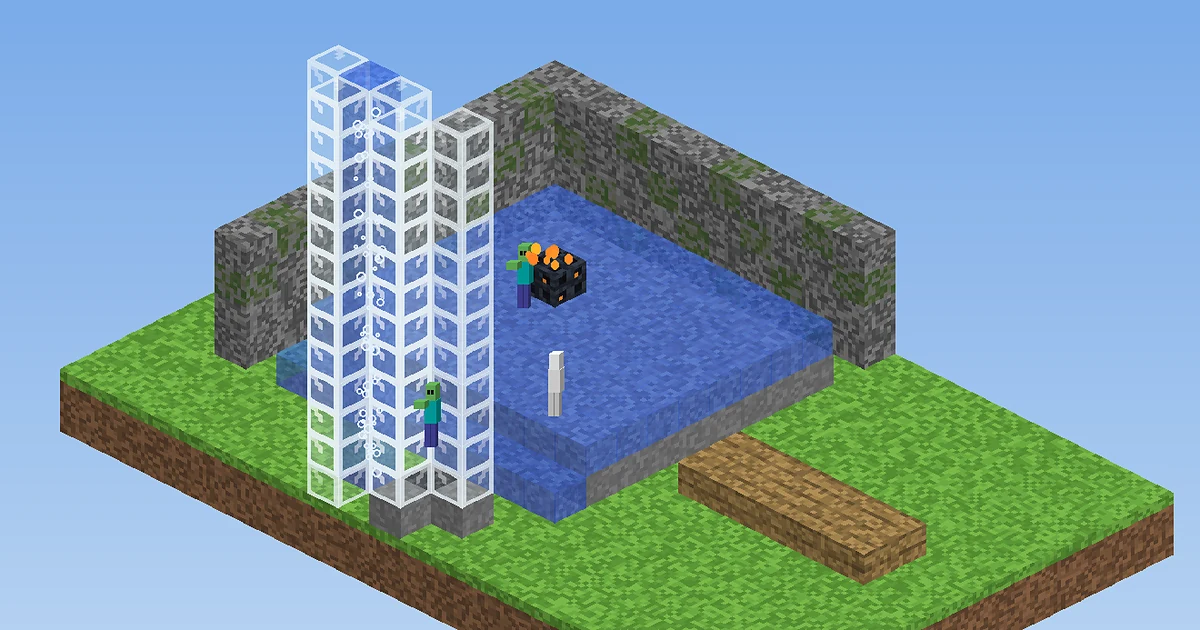
The fastest way to build an automatic XP farm in Minecraft is to find a zombie or skeleton spawner, wash its mobs into one spot with water, lift them up a soul sand elevator, and drop them 22 blocks so they land with half a heart left. You stand in a safe kill room and finish each one with a single sword swing. With rough materials gathered, most players can finish this automatic XP farm in one or two play sessions.
Key Takeaways
- A spawner-based automatic XP farm is the best first XP farm for most survival players.
- Mobs only drop XP when a player (or a tamed wolf) kills them, so “automatic” means the farm delivers mobs to you, not that it levels you up while you’re gone.
- A 22-block drop leaves zombies and skeletons with 1 health point in most cases.
- Your AFK spot must stay within 16 blocks of the spawner, or the farm switches off.
- Getting from level 0 to level 30 in Java Edition takes 1,395 XP, or about 279 zombie kills.
What an Automatic XP Farm Actually Does
Here’s the part most guides skip. Hostile mobs only drop experience orbs when they die to a player, or when a player damaged them shortly before death. The Minecraft Wiki’s experience page spells out these rules. If lava, cactus or fall damage kills a mob on its own, you’ll get its items but zero XP.
So an automatic XP farm is really an automatic delivery system. It spawns mobs, moves them, weakens them, and lines them up in front of you. Your only job is to swing a sword. That still beats hunting zombies in the dark by a mile.
Which Type of XP Farm Should You Build?
Not every automatic XP farm fits every world. Here’s how the common options stack up for a typical survival player.
| Farm type | What you need | XP speed | Best for |
|---|---|---|---|
| Spawner XP farm (zombie or skeleton) | A dungeon spawner, water, soul sand, glass | Medium | Early and mid game |
| Enderman farm | Access to the End’s outer islands (after the Ender Dragon) | Very high | Late game, Mending grinding |
| Guardian farm | A drained ocean monument | High | Big projects, prismarine |
| Furnace XP bank | Cactus or kelp farm feeding furnaces | Low but fully AFK | Storing XP while you’re away |
My recommendation: build the spawner version first. It uses cheap materials, works in both Java and Bedrock, and teaches you the mechanics behind every other automatic XP farm.
What You Need for an Automatic XP Farm
- A zombie or skeleton spawner (spider spawners need a different, wider design)
- 3 to 4 water buckets plus a nearby infinite water source
- 1 soul sand block (from the Nether’s soul sand valleys or Nether fortresses)
- About 3 stacks of building blocks (cobblestone works fine)
- About 2 stacks of glass for the elevator and drop shaft
- A few signs, 1 hopper (5 iron ingots plus a chest), and 1 or 2 chests
- Torches and a decent pickaxe
- An iron or diamond sword (Sharpness or Smite helps, Looting adds item drops)
New to survival basics like crafting hoppers or finding the Nether? Our Minecraft for beginners guide covers the fundamentals first.
How to Build an Automatic XP Farm Step by Step
Step 1: Find a Spawner for Your Automatic XP Farm
Every spawner-based automatic XP farm starts with a dungeon. Spawners sit inside small dungeon rooms made of cobblestone and mossy cobblestone, usually with one or two loot chests. You’ll hear a cluster of zombie groans or skeleton rattles through cave walls well before you see one. Caving with the volume up is honestly the best “spawner finder” in the game.
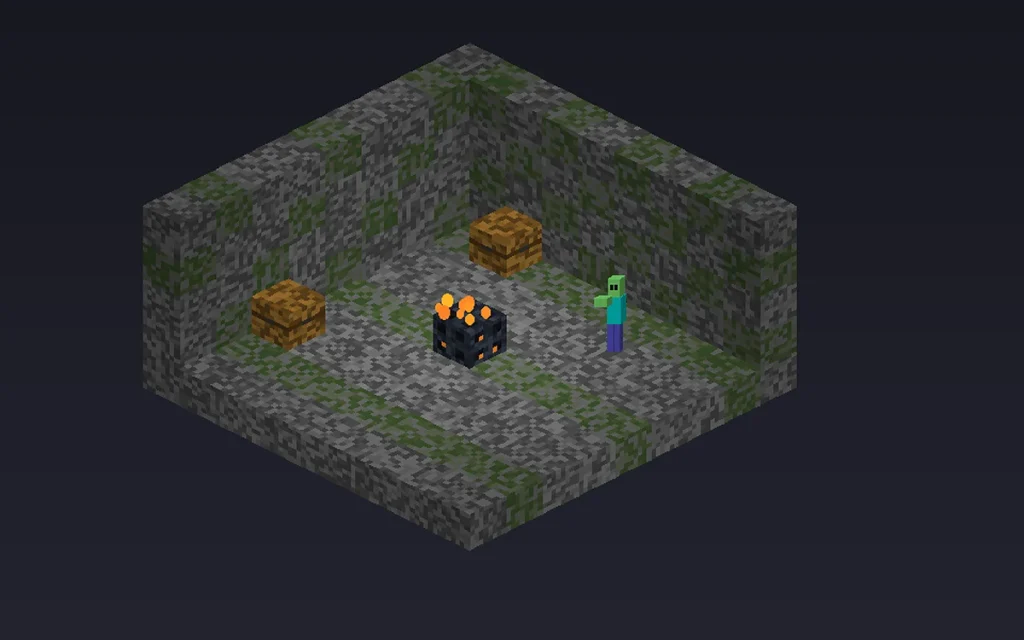
When you find one, place a torch on top of the spawner right away. Zombie and skeleton spawners need total darkness to spawn, so one torch shuts it down while you build. Don’t break it. Spawners can’t be picked up in survival, and a broken one is gone for good.
Skip the trial spawners found in trial chambers. They release a wave and then go quiet for about 30 minutes, which makes them a poor base for an automatic XP farm.
Step 2: Clear the Spawning Room
In Java Edition, a spawner places mobs within a 9 x 3 x 9 area centered on itself (4 blocks out in every direction, 1 block up or down). Dig the room out to 9 x 9 blocks with the spawner in the exact center, and make the floor two blocks below the spawner so there’s one block of air under it. Leave at least 3 blocks of headroom above the floor so tall mobs fit.
Spawners also stop working if 6 or more of their mobs are crowded nearby, according to the Minecraft Wiki’s monster spawner page. That’s why the next step, moving mobs out fast, matters so much.
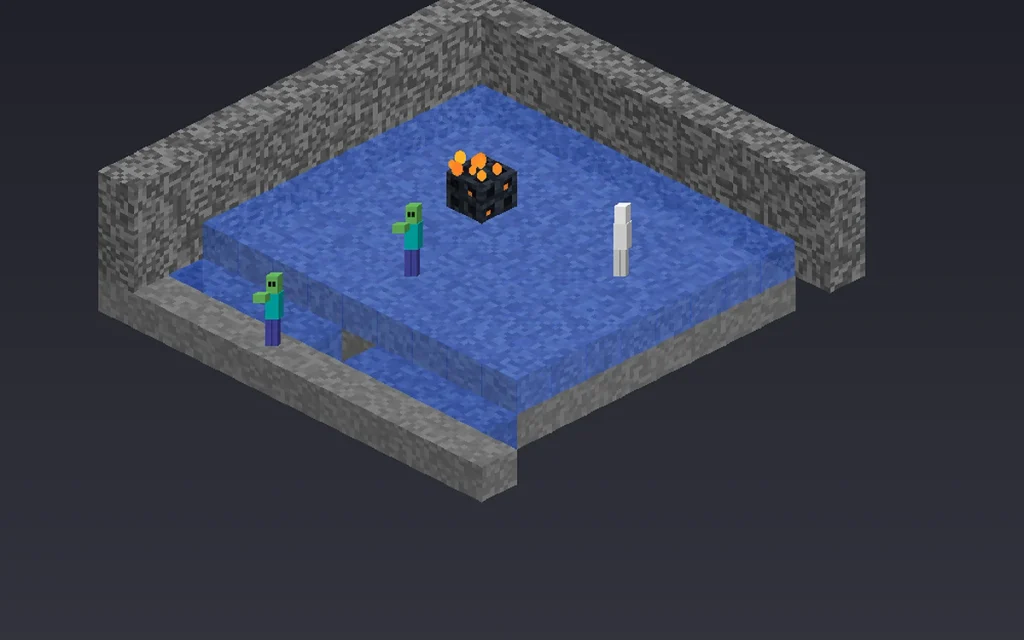
Step 3: Add the Water Floor and Collection Trench
Water flows 7 blocks out from a source block. That’s the number the whole automatic XP farm room is built around.
- Place water sources along the entire back wall (every block in that row). The water will cover the next 7 rows.
- Dig the front row (the 9th row) one block deeper to make a 1 x 9 trench. The water sheet stops right at its edge and pushes mobs over the lip.
- Put a water source at each end of the trench so both streams flow toward the middle.
- Dig a hole in the middle of the trench floor and place a sign on the wall inside that hole. In Java, the sign stops water from pouring down, but mobs fall straight through it.
Step 4: Build the Bubble Elevator
Here’s the catch that trips up first-time automatic XP farm builders. If you drop mobs 22 blocks straight down and stand at the bottom, you’ll be more than 16 blocks from the spawner and it shuts off. The fix is to send mobs up first.
Run a short 1-wide channel from the trench hole to a 1 x 1 glass tube. Put soul sand at the bottom of the tube and fill it with water source blocks about 24 blocks high. Soul sand creates an upward bubble column that shoots mobs to the top. Place a sign where the channel meets the tube so the elevator’s water doesn’t flow back and push mobs away.
Step 5: Build the 22-Block Drop
At the top of the elevator, add a water source on the far side so the current pushes mobs sideways into a separate 1 x 1 drop shaft. Use a sign at the shaft’s opening to keep that water from flowing down.
Fall damage is 1 point per block after the first 3. Zombies and skeletons have 20 health points, so a 22-block fall deals 19 damage and leaves them at half a heart. Build the shaft so mobs fall exactly 22 blocks and land at roughly the spawner’s height.
Step 6: Build the Kill Chamber and Hopper Line
The kill chamber is where your automatic XP farm pays out. Put a hopper at the bottom of the drop shaft and point it into a chest. Mobs land on the hopper, and their bones, rotten flesh, arrows and armor slide into storage.
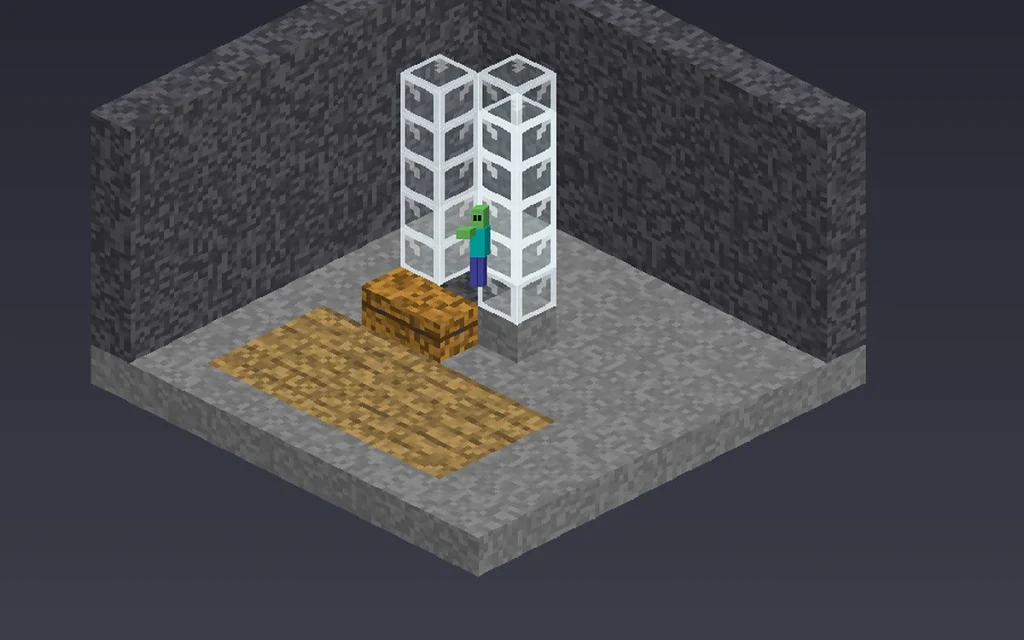
Leave a one-block gap at the mobs’ foot level and stand on the other side with your sword. Weakened mobs can still land the odd hit, so wear armor. Skeletons with bows are the main nuisance, which is one reason zombie spawners make the friendlier automatic XP farm.
Step 7: Confirm Your AFK Spot Is Within 16 Blocks
The spawner only runs while you’re within 16 blocks of it, measured as a sphere, so height counts too. In Java, press F3 to check coordinates for both your kill spot and the spawner. Walk to your spot, remove the spawner torch, and watch for the small flames that spin inside an active spawner.
How Much XP Can an Automatic XP Farm Make?
Expect a steady trickle rather than a flood. A spawner tries to place up to 4 mobs every 10 to 40 seconds, and many attempts fail. If it averages about 2 mobs every 25 seconds, that’s around 280 mobs an hour.
Zombies and skeletons drop 5 XP each. Java Edition players need 1,395 XP to go from level 0 to level 30, which works out to about 279 kills. In plain terms, a well-built automatic XP farm can take you from zero to a full enchanting table in roughly an hour of play. Your automatic XP farm numbers will vary with the spawner type and room shape.
Automatic XP Farm Differences in Java vs Bedrock
- Spawn area: Bedrock spawners use a slightly different spawn shape, so don’t fill the room’s corners with anything you can’t move later.
- Water and signs: Water handles signs and other non-full blocks a bit differently on Bedrock. Test each sign stop before building the rest. If water leaks, move the source blocks so the stream runs out (after its 7 blocks) right beside the hole instead.
- Fall damage: Some Bedrock players report mobs taking a little less damage after being pushed by water. If mobs survive with more than half a heart, add a block or two to the drop.
Common Automatic XP Farm Problems and Fixes
| Problem | Likely cause | Fix |
|---|---|---|
| Nothing spawns | You’re more than 16 blocks away, or light is leaking in | Move your AFK spot closer and remove torches from inside the room |
| Mobs die on landing | Drop is too tall, or mobs land on a pile and take cramming damage | Raise the landing floor one block and kill mobs as they arrive |
| Mobs get stuck on the floor | A gap in the water sheet | Add a source block in the dry spot’s row |
| Spawning slows down | Six or more mobs piled near the spawner | Check the trench and elevator for jams |
| XP orbs never show up | Mobs are dying without you hitting them | Make sure the final blow comes from you |
Tips to Get More From Your Automatic XP Farm
- Use Mending wisely. Orbs repair Mending gear before they count toward levels. Take off damaged Mending armor when you want to level up fast.
- Add Looting. It doesn’t raise XP, but it boosts bones, arrows and the occasional dropped armor.
- Pair it with a furnace XP bank. Furnaces store the XP from smelting until you pull the output by hand. In Java, smelting cactus into green dye gives 1 XP per item, which makes a nice fully AFK side farm.
- Follow along with a schematic mod. On Java, schematic mods like Litematica overlay a farm design in your world. Our guide to installing Minecraft mods on Windows walks through the setup.
- Check server rules before using an auto-clicker. Plenty of single-player fans use one at a spawner farm, but many multiplayer servers ban them.
Frequently Asked Questions
What is the easiest XP farm in Minecraft?
A zombie or skeleton spawner farm is the easiest automatic XP farm for most players. You only need a dungeon spawner, water, a soul sand block, glass and a hopper. It works in both Java and Bedrock, needs no redstone, and gives steady XP from the early game onward. Build it near your base if you can.
Can an automatic XP farm work while I’m AFK?
Partly. An automatic XP farm keeps spawning and moving mobs while you’re AFK nearby, but mobs only drop XP when a player kills them. You still need to swing your sword, or use an auto-clicker where it’s allowed. Furnace XP banks are the closest thing to fully passive XP, since furnaces store smelting XP for later.
How many blocks should mobs fall in an automatic XP farm?
Drop zombies and skeletons 22 blocks. They have 20 health points, fall damage equals 1 point per block after the first 3, so a 22-block fall leaves them with 1 health point. Test with your first few mobs. If they die on landing, raise the floor by one block. If they survive with more health, add a block.
Why is my mob spawner not spawning anything?
The most common reason an automatic XP farm stops is distance. A spawner only works while a player is within 16 blocks of it. Light is the second cause, since zombie and skeleton spawners need total darkness. Also check that six or more mobs aren’t crowded near the spawner, and that your world isn’t set to Peaceful difficulty.
How much XP do you need to reach level 30?
In Java Edition, you need 1,395 total experience points to go from level 0 to level 30. Since zombies and skeletons drop 5 XP each, that’s about 279 kills from scratch. Level 30 is the number to aim for, because it gives you the strongest enchantments on an enchanting table with 15 bookshelves.
Is an Enderman farm better than a spawner XP farm?
For raw speed, yes. An Enderman farm in the End’s outer islands produces XP much faster than a dungeon spawner. It’s a late-game build, though, since you need to beat the Ender Dragon first and haul materials to the outer islands. Most players build a spawner automatic XP farm first and an Enderman farm later.
Your Next Step: Put That XP to Work
Once your automatic XP farm is running, set up an enchanting table with 15 bookshelves within reach of your kill room. Run the automatic XP farm until you hit level 30, enchant your sword and armor, then go after Mending from librarian villagers so your gear repairs itself every time you farm. Start by finding that first spawner, and the rest of the build follows naturally.