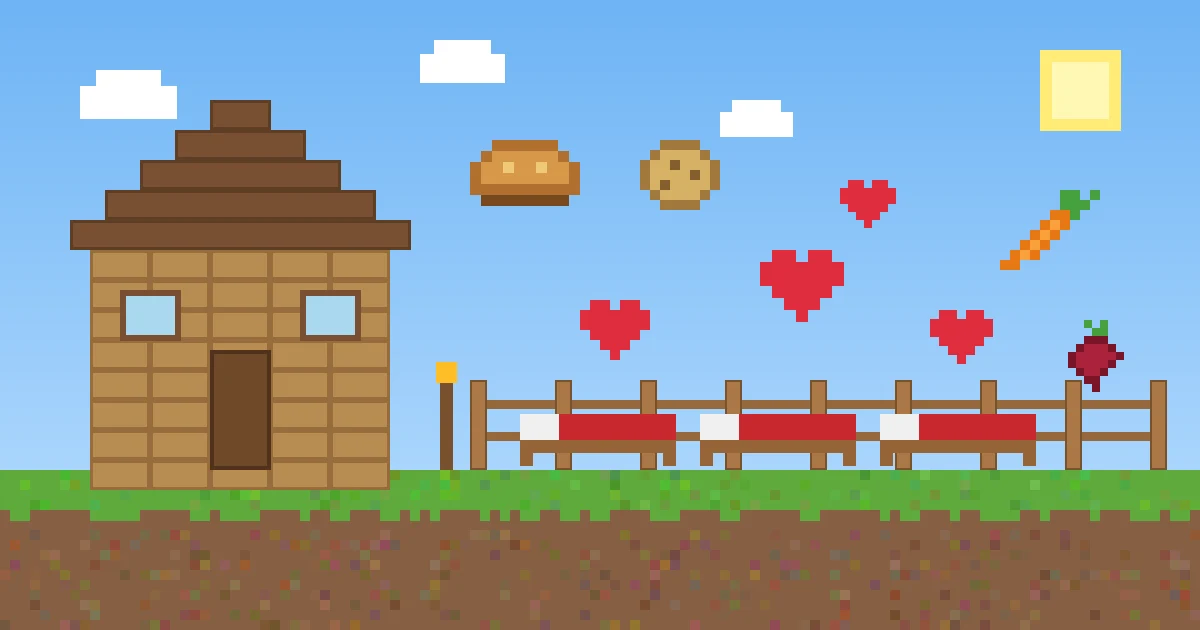
To get villagers to breed in Minecraft, you need two things at the same time: villagers who are “willing” (they’re carrying enough food) and at least one free bed they can reach. Drop 3 bread or 12 carrots, potatoes, or beetroots near each villager, place a few extra beds, and they’ll take care of the rest on their own.
That’s the short version. Below you’ll find the exact food math, the bed rules that trip up most players, a simple breeder you can build in about 10 minutes, and fixes for the most common “my villagers won’t breed” problems. Everything here works in both Java Edition and Bedrock Edition (PC, Xbox, PlayStation, Switch, and mobile), and I’ll call out the spots where the two versions behave differently.
Key Takeaways
- Villagers breed only when they’re willing (12 food points, which is 3 bread or 12 carrots, potatoes, or beetroots) and an unclaimed bed is nearby.
- You can’t hand food to a villager. Drop it on the ground near them, or let a farmer villager share its crops.
- Always place more beds than you have villagers. Every baby needs a bed of its own.
- Babies grow up in about 20 minutes (one full Minecraft day), and parents wait 5 minutes before they can breed again.
- No baby? Check beds first, then food, then whether the villagers can actually reach each other.
What Villagers Need to Breed in Minecraft
Villager breeding isn’t like breeding cows or sheep. You don’t right-click them with food. Instead, the game checks two separate conditions, and both have to be true at once. Miss either one and nothing happens, no matter how long you wait.
1. Willingness (Food)
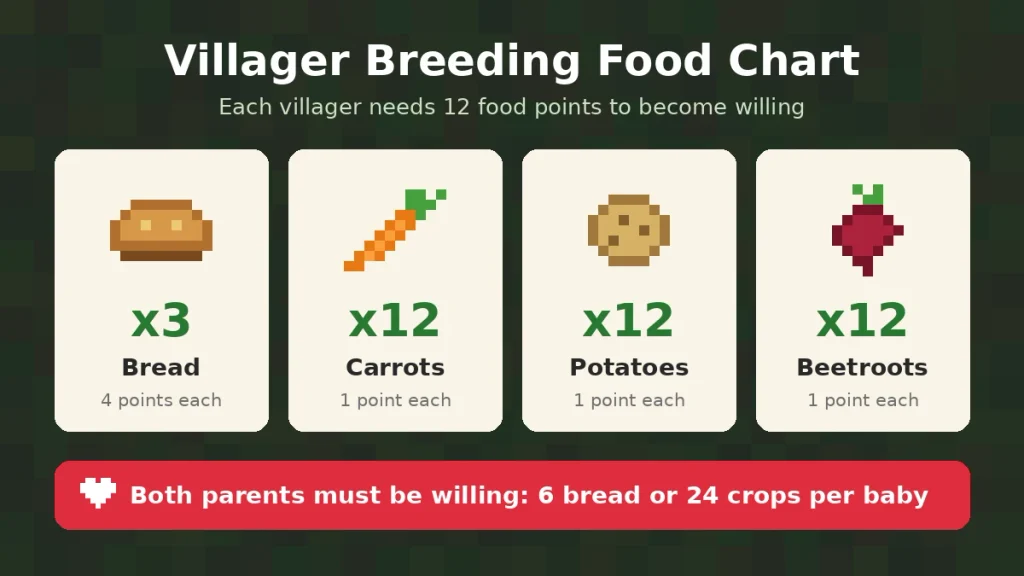
A villager becomes willing once it holds enough food in its inventory. According to the Minecraft Wiki’s breeding page, that means 3 bread or 12 carrots, potatoes, or beetroots. Behind the scenes, the game counts food points, and a villager needs 12 of them.
| Food | Food points each | Amount for one willing villager | Where to get it |
|---|---|---|---|
| Bread | 4 | 3 | Craft from 3 wheat |
| Carrots | 1 | 12 | Village farms, zombie drops |
| Potatoes | 1 | 12 | Village farms, zombie drops |
| Beetroots | 1 | 12 | Village farms, seeds from chests and grass |
Here’s the catch: both parents need to be willing. So for one baby, you need at least 6 bread or 24 carrots in total. I usually toss in a little extra because villagers love to pass food around, and some of it always ends up with the wrong villager.
Wheat, apples, cooked meat, and golden carrots won’t work. Only the four foods in the table count.
2. Free Beds
Beds act as a population cap. Each adult villager claims a bed, and a new baby only spawns if there’s an unclaimed bed waiting for it. If you have 2 villagers and 2 beds, they’ll never breed. Give them 3 beds and you’ll get one baby. Give them 6 and the village can grow to 6.
A few bed rules worth knowing:
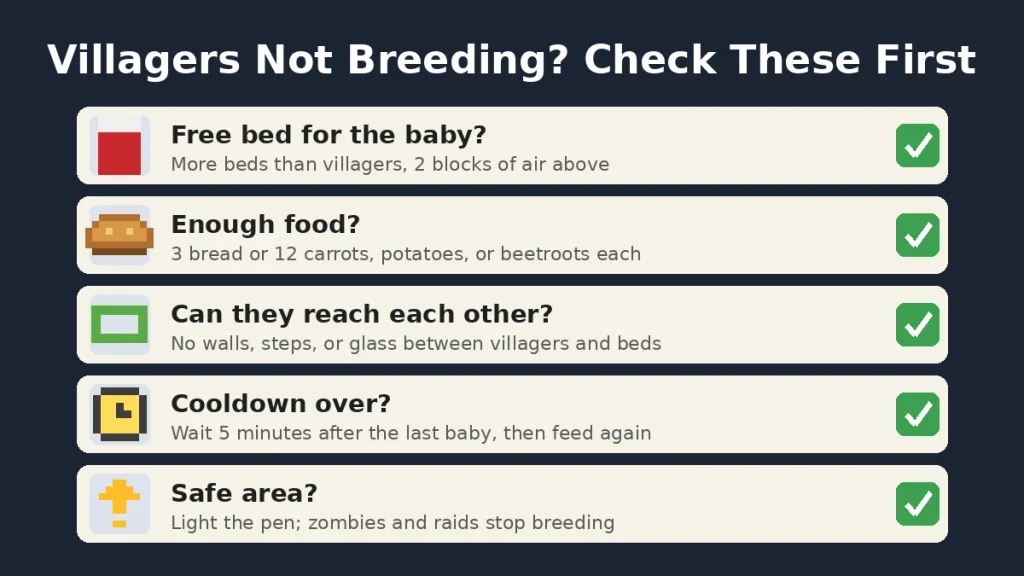
- Leave two blocks of open air above each bed. A slab or block right on top of a bed can stop it from counting.
- Villagers have to be able to walk to it. A bed behind glass or up a step they can’t climb doesn’t help.
- Java vs. Bedrock: In Java Edition, breeding needs at least one unclaimed bed in reach. In Bedrock Edition, the village needs more beds than adult villagers. The fix is the same in both: add extra beds.
You can tell when a bed is claimed. Green particles appear over a villager’s head the moment it links to a bed or job block.
How to Breed Villagers Step by Step
This is the basic villager breeding method that works in any village or survival base.
- Get at least two villagers. Use a natural village, or move villagers with a boat or minecart. Curing a zombie villager also works if you’re far from a village.
- Fence them in. A small, enclosed pen keeps them from wandering off and keeps zombies out. A 5 x 5 space is plenty for two villagers.
- Place extra beds. For two villagers, place at least three beds. I like to place four so I get two babies before I need to add more.
- Drop the food. Stand close and drop 3 bread or 12 crops near each villager. On PC that’s the Q key. On console, use your drop button (B on Xbox by default). Watch the items disappear from the ground to confirm they picked them up.
- Watch for hearts. When both villagers are willing, they walk together, stare at each other for a moment, and red heart particles appear. Angry gray clouds instead of hearts mean they were willing but couldn’t find a free bed.
- Wait for the baby to grow. A baby villager takes about 20 minutes of real time to become an adult. Babies can’t trade or work until then.
After breeding, the parents need 5 minutes before they can try again, and they’ll need fresh food. Their old food was used up making the baby.
How to Build a Simple Automatic Villager Breeder
Dropping bread by hand gets old fast. A self-feeding villager breeder fixes that by letting a farmer villager grow and share the food for you. Once it’s running, you can walk away and come back to more villagers.
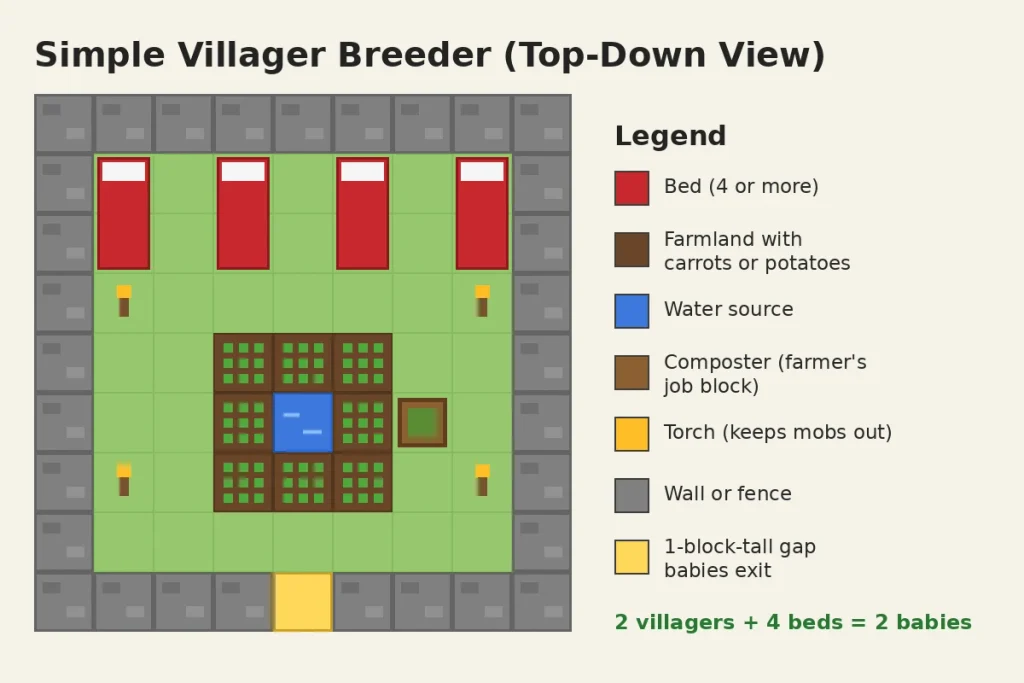
What You’ll Need
- 2 villagers (one will become a farmer)
- 1 composter (the farmer’s job block)
- About 9 farmland blocks with a water source in the middle
- Carrot or potato seed crops (potatoes are my pick because they give extra drops)
- 4 or more beds
- Fences or solid blocks for walls, plus torches or other light
How to Set It Up
- Build a walled area about 9 x 9 blocks (walls included) and light it well so hostile mobs can’t spawn inside.
- Make a 3 x 3 patch of farmland with water in the center, and plant carrots or potatoes.
- Place a composter next to the farm. An unemployed villager will claim it and become a farmer.
- Put your beds along one wall, with two blocks of air above each.
- Move both villagers inside and drop a starter batch of food to kick things off.
The farmer harvests the crops, replants them, and tosses extra food to the other villager. When they both hit 12 food points, they breed. One trick I use: leave a gap that’s one block tall in the wall. Babies are short enough to walk through it, but adults aren’t, so new villagers slowly leave the pen on their own and free up their beds.
Why Are My Villagers Not Breeding?
If your villagers are not breeding, the problem is almost always one of the issues below. Work down the list in order. Beds cause more failures than everything else combined.
| Problem | What you’ll see | Fix |
|---|---|---|
| No free bed | Angry gray clouds over the villagers | Add more beds than villagers |
| Bed is blocked | No green particles over the bed’s owner | Clear two blocks of air above it and make sure it’s reachable |
| Not enough food | No hearts at all | Drop 3 bread or 12 crops per villager |
| Wrong food | Villagers ignore or keep the item | Use only bread, carrots, potatoes, or beetroots |
| Cooldown | They bred recently | Wait 5 minutes and feed them again |
| Can’t reach each other | Villagers stuck in separate spaces | Remove walls or blocks between them |
| mobGriefing is off (Java) | Food sits on the ground untouched | Run /gamerule mobGriefing true |
Zombies and raids also stop breeding. Villagers panic and run for shelter instead of looking for a partner, so keep your breeder lit and walled off. For the full list of villager behaviors, the Minecraft Wiki’s villager page is the most detailed reference out there.
Tips From Long-Running Survival Worlds
- Keep your breeder away from your trading hall. Grown babies wander off looking for job blocks and can steal a workstation you set up for a specific trader.
- Use bread early, crops later. Bread packs 4 food points per item, so it’s the fastest way to get your first few babies. Once a farmer is working, let the crops do the job.
- Don’t overfill with beds. Every extra bed is another villager. If you only want 10, place 10 beds and the population stops there.
- Light everything. Hostile mobs spawn at a light level of 0, so a few torches around the pen prevent most zombie trouble.
Your Next Step
Start small. Fence in two villagers, place four beds, and drop 6 bread. You should see hearts within a minute or two. Once that works, upgrade to the farmer-powered breeder above and you’ll never have to feed them by hand again. More villagers means more trades, more librarians to roll for enchanted books, and an iron golem or two guarding your base.
New to the game? Our Minecraft for beginners guide covers the basics, and when you’re ready for Netherite gear, read how to find and use Ancient Debris in Minecraft.
Frequently Asked Questions
What do villagers need to breed in Minecraft?
Villagers need to be willing and have an unclaimed bed nearby. They become willing when each one holds 12 food points, which means 3 bread or 12 carrots, potatoes, or beetroots. Both parents must be willing, and the baby needs a free bed with open space above it, or breeding won’t happen.
How many beds do villagers need to breed?
You need at least one more bed than you have adult villagers. Two villagers need three beds to make one baby. Each new villager claims a bed, so the number of beds sets the maximum population. If you want the village to keep growing, keep adding beds with two blocks of air above each.
Why are my villagers not breeding even with food and beds?
The beds are usually the problem. They might be blocked, unreachable, or already claimed. Angry gray clouds mean no free bed was found. Also check that both villagers picked up enough food, that they can reach each other, that no zombies are nearby, and that mobGriefing is on in Java Edition.
How long does it take for a baby villager to grow up?
A baby villager takes about 20 minutes of real time to grow into an adult, which equals one full Minecraft day. Babies can’t trade or take a job until they grow up. Meanwhile, the parents need a 5-minute cooldown and fresh food before they can breed again.
Can you feed villagers directly in Minecraft?
No. Unlike farm animals, villagers can’t be fed by right-clicking or tapping. You have to drop food on the ground near them (Q on PC, or the drop button on console) so they pick it up. Farmer villagers also share their extra crops with other villagers automatically.
Do villagers need a job to breed?
No. Unemployed villagers breed just as well as employed ones, as long as they have enough food and a free bed. Jobs only matter for trading. That said, giving one villager a composter turns it into a farmer, which makes it grow and share food so breeding happens on its own.