The quickest way to find diamonds in Minecraft is to dig down to Y level -59 (or -58) with an iron pickaxe and branch mine in straight tunnels, checking every wall as you go. That layer sits just above the bedrock floor, where diamond ore shows up most often in every version since the Caves & Cliffs update. If you’ve been wondering how to find diamonds in Minecraft without wasting hours, this guide covers the exact depth, the gear to bring, the tunnel layout that works, and the mistakes that keep most players empty-handed.
Key Takeaways
- Mine at Y -59 or -58. Diamonds generate from Y 16 down to the bottom of the world, and they get more common the deeper you go.
- You need an iron, diamond, or netherite pickaxe. Anything weaker breaks the ore and drops nothing.
- Branch mining (one main tunnel with side tunnels every 3 blocks) is the most reliable method. Exploring deep caves is faster but riskier.
- A Fortune III pickaxe can drop up to 4 diamonds per ore block, so save diamond ore for it when you can.
- The old “Y 11 or 12” advice only applies to Minecraft 1.17 and earlier. Ignore it.
Where Diamonds Spawn in Minecraft Today
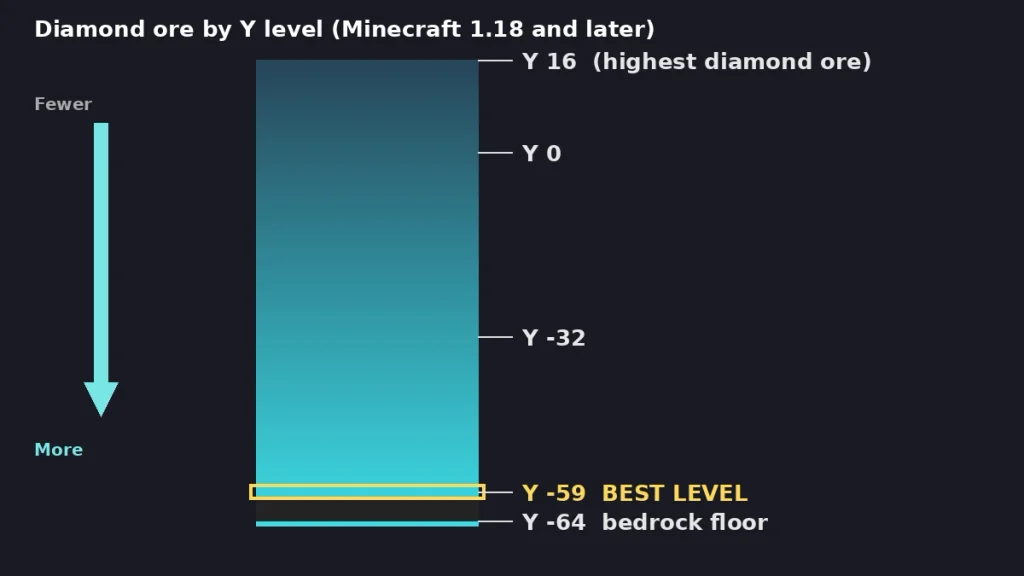
Diamond ore generates anywhere from Y 16 down to Y -64, the bottom of the Overworld. It’s rare near the top of that range and gets steadily more common as you head toward bedrock. Above Y 16, you won’t find a single natural diamond ore block, so time spent mining near sea level is wasted.
This changed with Minecraft 1.18 (Caves & Cliffs: Part II), released on November 30, 2021, which pushed the world floor down to Y -64. That’s why so many older YouTube videos and guides still tell you to mine at Y 11. On any current version of Java or Bedrock Edition, that advice puts you in one of the worst diamond layers.
Most of the diamonds you’ll see below Y 0 will be deepslate diamond ore. It looks darker and takes longer to break, but it drops the same diamond. You’ll also notice veins are small, usually one to a handful of blocks, so finding one vein means you should mine out every connected block before moving on.
| Y Level | What to Expect |
|---|---|
| Above 16 | No diamond ore at all |
| 16 to 0 | Rare, occasional single blocks |
| 0 to -50 | Better odds, but not the sweet spot |
| -53 to -59 | Best range for diamonds |
| -60 to -64 | Bedrock mixed in, awkward to mine |
The Best Y Level for Diamonds (and How to Check Yours)
The best Y level for diamonds is -59, with -58 just as good in practice. Bedrock generates randomly between Y -64 and Y -60, so tunneling any lower means constantly bumping into unbreakable blocks. A 2-block-tall tunnel with your feet at Y -59 clears layers -59 and -58, both of which sit right in the densest diamond zone.
Checking Coordinates in Java Edition
Press F3 (Fn + F3 on many laptops, including most MacBooks) to open the debug screen. Look for the line labeled XYZ. The middle number is your Y level.
Checking Coordinates in Bedrock Edition
On Xbox, PlayStation, Nintendo Switch, mobile, and the Windows version, open your world’s settings and turn on Show Coordinates. Your position will then display in the top-left corner of the screen. The second number is your Y level, same as Java.
What to Bring Before You Start Mining
A diamond run at Y -59 means a long walk back if you die, and your stuff sits next to lava. Pack properly once and you’ll save yourself a lot of frustration.
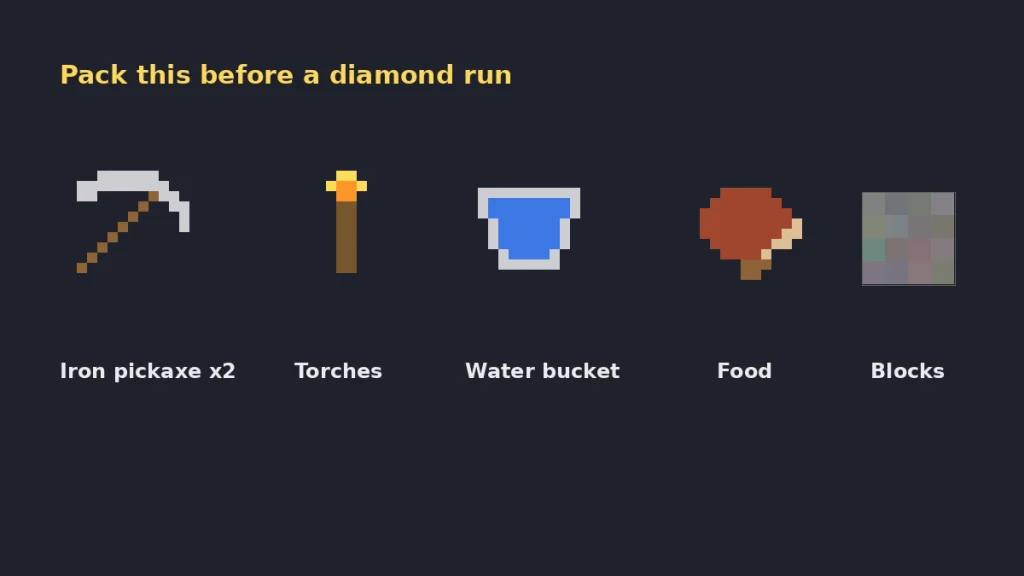
- Two or three iron pickaxes. Iron is the minimum tier that can mine diamond ore. A stone or gold pickaxe breaks the block and gives you nothing.
- A stack (64) or more of torches. Light keeps mobs from spawning in your tunnels.
- A water bucket. It turns lava into obsidian or cobblestone and can save your life in a fall.
- Food. Cooked steak or pork chops are ideal. Mining drains your hunger bar fast.
- Building blocks. Half a stack of cobblestone lets you wall off lava and water.
- Iron armor and a shield if you have them. Skeletons and creepers love deep caves.
One more tip from experience: put an Efficiency enchantment on your pickaxe if you can. Deepslate takes about twice as long to break as regular stone, and Efficiency makes branch mining feel far less like a chore.
Branch Mining in Minecraft: The Most Reliable Method
Branch mining is the method I recommend for most players because it’s safe, systematic, and works in any seed. You won’t find diamonds in the first five minutes every time, but you’ll find them consistently.
- Step 1: Get down safely. Dig a staircase down to Y -59. Never dig straight down under your own feet, because you can drop into a cave or a lava pool with no warning.
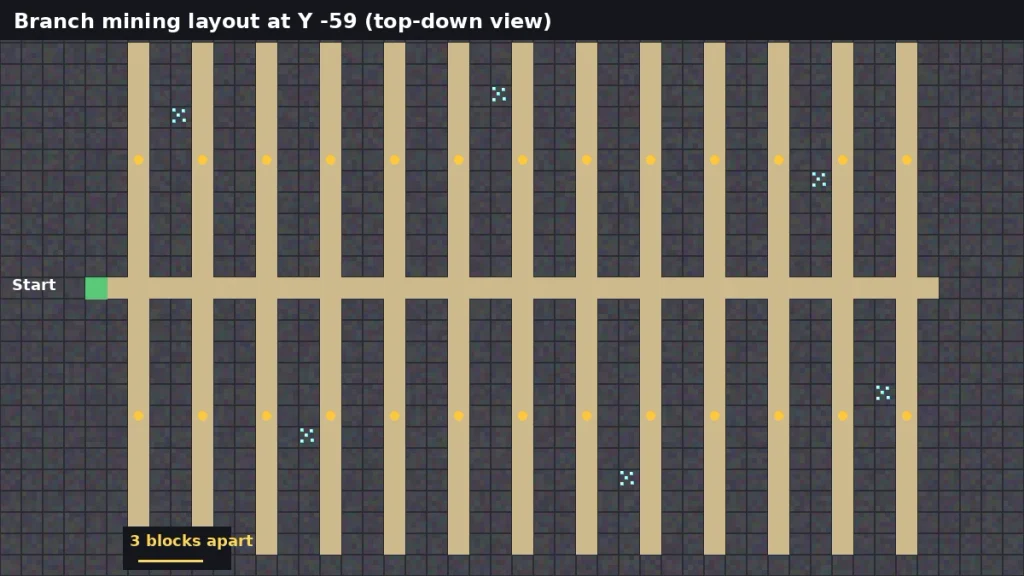
- Step 2: Dig a main tunnel. Make a straight hallway 2 blocks tall and 1 or 2 blocks wide, about 30 to 50 blocks long.
- Step 3: Add side branches. Every 3 blocks along the main tunnel, dig a 2-block-tall branch off to each side, around 20 to 30 blocks long. Leaving 2 solid blocks between branches means you see every block without mining it.
- Step 4: Place torches on one side only. Always place them on the right wall, for example. When you want to go back, keep the torches on your left and you’ll find the exit.
- Step 5: Scan every wall, floor, and ceiling. Diamond ore has light blue specks. When you spot one, mine around it to find the rest of the vein.
When you hear lava bubbling or see it dripping from the ceiling, slow down. Lava pools and lava lakes are very common at this depth. Mine one block at a time, and if lava starts flowing toward you, block it off with cobblestone or pour your water bucket on it.
Other Ways to Find Diamond Ore
Explore Deep Caves
Big caves and ravines that reach below Y -50 expose huge amounts of stone at once, so you can spot diamond ore on the walls without digging. It’s faster than branch mining when it works, but caves are darker and full of mobs. The game also cuts back on how much diamond ore generates while touching open air, so a cave wall won’t hold as many diamonds as the same amount of solid stone. Use caves for quick looks and branch mining for steady results.
Loot Chests in Structures
You can also grab diamonds without mining at all. Chests in village toolsmith and weaponsmith houses, shipwrecks, buried treasure, desert pyramids, and End cities all have a chance to contain diamonds. Treat it as a bonus, not a plan.
If you’re brand new and still getting your first tools together, our guide to Minecraft for beginners walks you through your first few days before you start deep mining.
Get More Diamonds With a Fortune Pickaxe
Fortune is the single biggest upgrade for diamond farming. A Fortune III pickaxe can drop up to 4 diamonds from a single ore block and averages a little over 2 per block, according to the Minecraft Wiki’s Fortune page. Without Fortune, every ore gives exactly one diamond.
Here’s the strategy experienced players use. Once you have a Silk Touch pickaxe, mine diamond ore with it to collect the ore block itself. Store those blocks in a chest, then mine them all at once after you get Fortune III. You lose nothing by waiting, and you could nearly double your haul.
To get Fortune III reliably, you’ll need an enchanting table surrounded by 15 bookshelves, which gives you access to level 30 enchantments. That table itself costs 2 diamonds, so your very first diamonds should usually go toward it, not a sword.
Common Mistakes That Keep You From Finding Diamonds
- Mining at the wrong level. Y 11 and Y 12 were the old sweet spots. On current versions, go to -59.
- Using a stone pickaxe. The ore breaks and drops nothing. Always check your hotbar.
- Making branches too close together. Branches with only 1 block between them waste time mining stone you could already see.
- Ignoring the ceiling and floor. Diamonds can sit directly above or below your tunnel. Look up and down as you walk.
- Skipping torches. Dark tunnels spawn mobs behind you, and a creeper explosion near lava can end your run fast.
How Many Diamonds Do You Actually Need?
It helps to have a target before you head down. A full set of diamond armor takes 24 diamonds (helmet 5, chestplate 8, leggings 7, boots 4). A pickaxe, sword, axe, shovel, and hoe add 11 more, for 35 total. Add 2 for the enchanting table and a few spare for a jukebox or diamond block projects later on.
Start Your First Diamond Run Today
Craft two iron pickaxes, grab a water bucket and a stack of torches, then staircase down to Y -59 and start your main tunnel. Give branch mining 20 to 30 minutes of steady work before you judge it, and save any diamond ore you can for a Fortune III pickaxe. Parents setting up Minecraft on a console for their kids can also check our guide on how to set up parental controls on Xbox, and anyone who wants the full ore data can read the official Diamond Ore page on the Minecraft Wiki.
Frequently Asked Questions
What is the best Y level for diamonds in Minecraft?
The best Y level for diamonds is -59, with -58 nearly identical. Diamond ore generates from Y 16 down to Y -64 and becomes more common the deeper you go. Bedrock starts appearing below Y -59, so mining at -59 gives you the highest diamond density without constantly running into unbreakable blocks.
Can you mine diamonds with a stone pickaxe?
No. Diamond ore only drops a diamond when you mine it with an iron, diamond, or netherite pickaxe. If you use a wooden, stone, or gold pickaxe, the block breaks and disappears without dropping anything. Always check that an iron pickaxe or better is in your hand before you mine a diamond vein.
Why can’t I find any diamonds in Minecraft?
Most players who can’t find diamonds are mining too high, often at Y 11 from older guides. Go down to Y -59 and branch mine with side tunnels every 3 blocks. Also check ceilings and floors, not just walls. Diamonds are rare, so expect to mine for 20 minutes or more before your first vein.
Are diamonds at the same Y level in Java and Bedrock?
Yes. Since the 1.18 update, Java Edition and Bedrock Edition use the same diamond range, from Y 16 down to the bottom of the world, with the best results around Y -59. The only real difference is how you check coordinates: F3 in Java, and the Show Coordinates world setting in Bedrock.
How many diamonds can you get from one ore?
Without enchantments, each diamond ore block drops exactly one diamond. With a Fortune III pickaxe, a single block can drop up to four diamonds, averaging a little over two. That’s why many players mine diamond ore with Silk Touch first, store the blocks, and break them later with Fortune III.
Do diamonds spawn near lava in Minecraft?
Diamonds don’t spawn near lava on purpose, but both are common at the same depth. Lava pools and lakes appear often below Y -50, which is why players frequently spot diamonds beside them. Carry a water bucket and building blocks so you can safely seal off lava before mining any ore next to it.