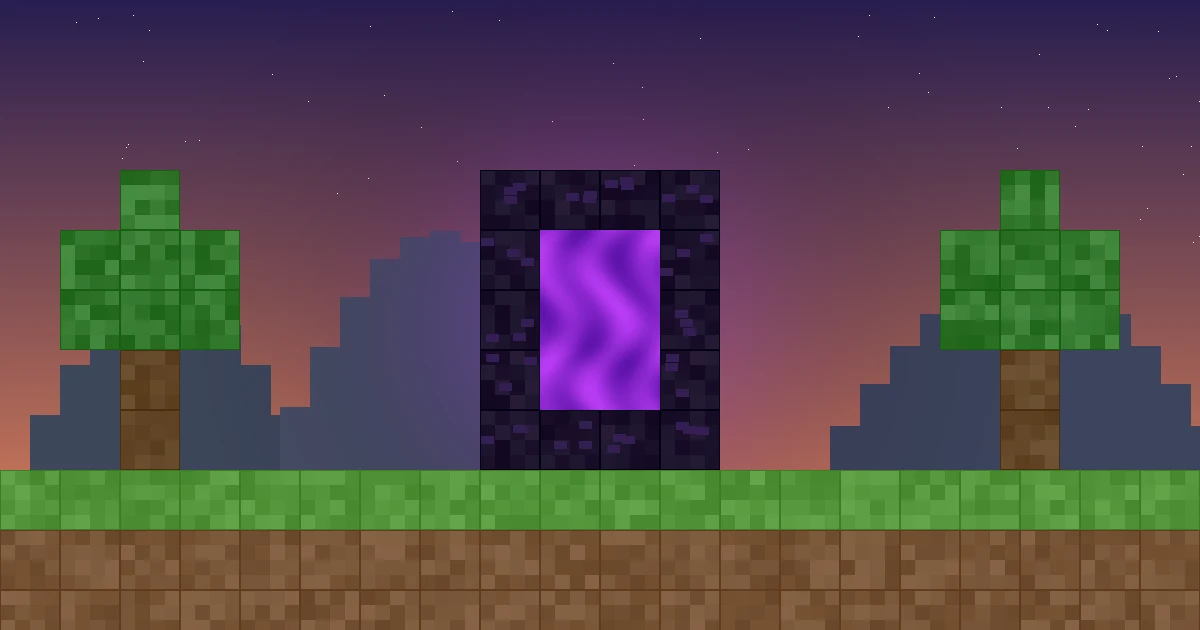
To make a Nether portal in Minecraft, build an upright obsidian frame at least 4 blocks wide and 5 blocks tall, then light the inside with flint and steel. You only need 10 obsidian blocks because the four corners are optional. The steps are the same on Java Edition and Bedrock Edition (Xbox, PlayStation, Switch, PC, and mobile).
Below you’ll find how to get obsidian without a diamond pickaxe, how to light the portal on every platform, and what to check when your portal refuses to turn on.
Key Takeaways
- 10 obsidian is the minimum. A full 4×5 frame uses 14, but the corners aren’t required.
- The opening must be at least 2 blocks wide and 3 blocks tall, and the frame has to stand upright.
- Light it with flint and steel or a fire charge. Crying obsidian won’t work in the frame.
- No diamond pickaxe? Cast the frame with a water bucket and lava, or repair a ruined portal.
- 1 block in the Nether equals 8 blocks in the Overworld, so write down your coordinates before you go.
What You Need to Build a Nether Portal
There’s no crafting recipe for a Nether portal. You build it in the world like any other structure, so the shopping list is short.
| Item | How Many | Where to Get It |
|---|---|---|
| Obsidian | 10 (or 14 with corners) | Water touching a lava source block, ruined portals, some chests |
| Flint and steel | 1 | Craft 1 iron ingot + 1 flint (flint drops from gravel) |
| Fire charge (optional) | 1 | Craft blaze powder + coal or charcoal + gunpowder |
| Water bucket (for casting) | 1 | Craft a bucket from 3 iron ingots, then fill it |
| Temporary blocks | A few | Dirt or cobblestone to hold the frame while you build |
My advice: craft the flint and steel before you start. Gravel only drops flint about 10% of the time without the Fortune enchantment, so it can take a dozen or more blocks of gravel to get one piece.
Nether Portal Size: Minimum and Maximum Dimensions
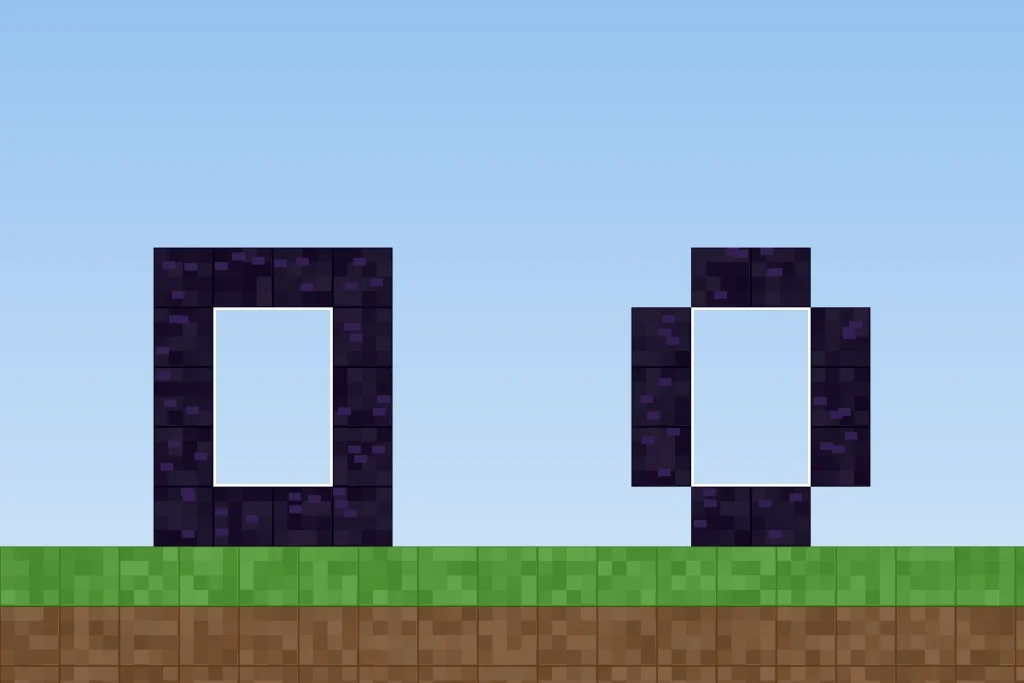
The smallest working Nether portal size is 4 blocks wide by 5 blocks tall on the outside, which leaves a 2×3 opening in the middle. The largest is 23×23, with a 21×21 opening. Any rectangle between those limits works, as long as the frame is vertical. You can’t lay a Nether portal flat on the ground.
- Minimum frame: 4 wide x 5 tall (10 obsidian without corners, 14 with)
- Maximum frame: 23 wide x 23 tall
- Shape: rectangle only, standing upright
- Corners: optional, and they can be any block (or nothing at all)
Stick with the 4×5 build for your first portal. Obsidian is slow to collect early in the game, and a bigger portal doesn’t get you to the Nether any faster.
How to Get Obsidian for Your Portal
Obsidian forms when water touches a lava source block. You’ll find lava pools in caves, near ravines, and on the surface in some biomes. Here are three ways to get the 10 blocks you need.
1. Mine It With a Diamond Pickaxe
Only a diamond or netherite pickaxe can collect obsidian. Any weaker pickaxe will break it eventually, but nothing drops. An unenchanted diamond pickaxe takes about 9.4 seconds per block, so stand on a safe block and keep an eye out for lava flowing back toward you.
2. Build a Nether Portal Without a Diamond Pickaxe (Casting)
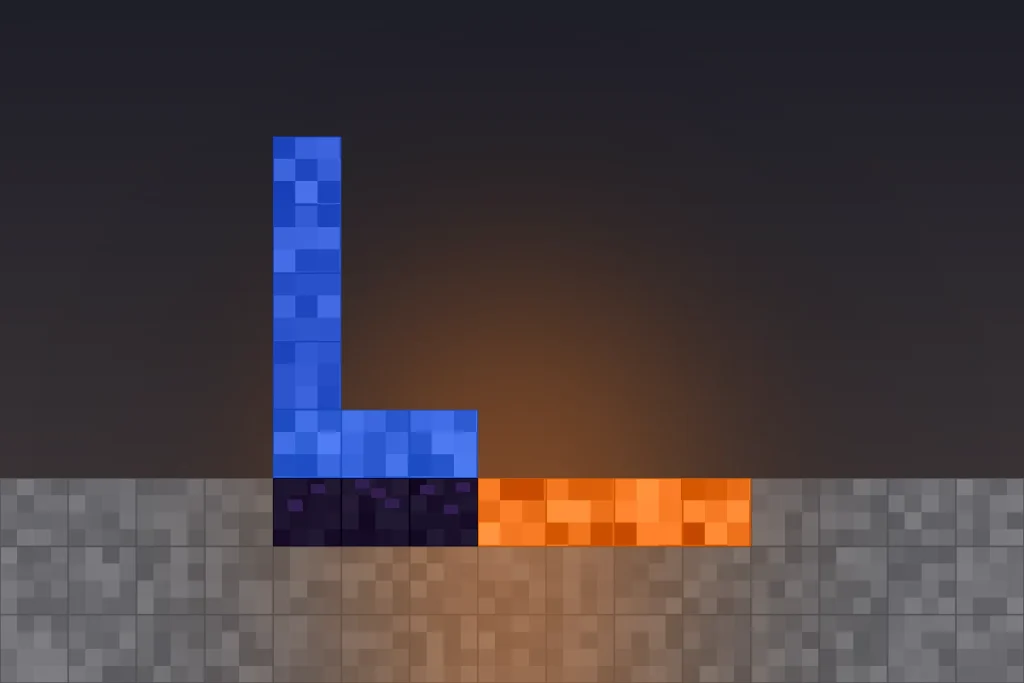
This is the method most experienced players use early in a world. You shape a mold out of dirt or cobblestone, pour lava where each obsidian block should go, and then pour water over it to turn the lava into obsidian right in place. You never mine anything.
- Bring 1 water bucket and 1 or 2 empty buckets for lava.
- Build the bottom row first, then work up the sides one block at a time.
- Scoop the water back up after each block so it doesn’t spread.
- Keep the mold well away from wood, grass, and leaves, since lava sets them on fire.
It takes some patience the first time, but once you get the rhythm you can finish the whole frame next to a single lava pool.
3. Repair a Ruined Portal
Ruined portals spawn naturally in the Overworld. They’re half-broken frames surrounded by netherrack and gold blocks, usually with a loot chest that can hold obsidian, flint and steel, or a fire charge. Fill in the missing pieces and light it.
One catch: ruined portals often include crying obsidian (the purple, dripping kind). It looks close enough, but the game won’t accept it as part of a portal frame. Swap every crying obsidian block for regular obsidian before you try to light it.
How to Make a Nether Portal in Minecraft: Step-by-Step
Once you have 10 obsidian and a way to light it, the build takes about a minute.
- Pick a flat, safe spot. Clear an area at least 4 blocks wide and 5 blocks tall. Build near your base so you can find your way home.
- Place the bottom row. Put 2 obsidian blocks side by side on the ground. (Use 4 if you want corners.)
- Build the side pillars. Stack 3 obsidian on each side, starting one block up and one block out from the bottom row. If a block won’t place, set a dirt block underneath as support and break it later.
- Add the top row. Place 2 obsidian across the top to close the frame. A temporary dirt block helps you reach and place these.
- Clear the inside. Remove any dirt, tall grass, torches, or snow from the 2×3 opening.
- Light the frame. Equip flint and steel and use it on the inside face of a bottom obsidian block.
- Step in and wait. Stand in the purple swirl for about 4 seconds in Survival mode, and the game will take you to the Nether.
How to Light a Nether Portal on Every Platform
You light the portal with the “use item” button while holding flint and steel or a fire charge. Here’s where that button lives on each system.
| Platform | Button to Light the Portal |
|---|---|
| PC (Java or Bedrock) | Right-click |
| Xbox Series X|S / Xbox One | Left trigger (LT) |
| PlayStation 5 / PS4 | L2 |
| Nintendo Switch | ZL |
| iPhone, iPad, Android | Tap the inside of the frame |
Lighting a Portal Without Flint and Steel
A fire charge works exactly like flint and steel, and you’ll often find one in ruined portal chests. Fire from another source can also light the frame. A lava block placed near flammable blocks can spread fire into the opening, but it’s unreliable and burns down anything wooden nearby. Flint and steel is still the easiest option.
Why Your Nether Portal Won’t Light
If you click and nothing happens, it’s almost always one of these:
- The frame has a gap. Every side block must be obsidian. Corners don’t matter, but sides do.
- You used crying obsidian. Replace it with regular obsidian.
- Something is inside the opening. Even one tall grass or snow layer can block it.
- The frame is too small or too big. The opening must be between 2×3 and 21×21.
- The frame is flat. Nether portals only work standing upright.
- You’re in the End. Nether portals won’t activate in the End dimension.
Nether Portal Coordinates: The 8-to-1 Rule
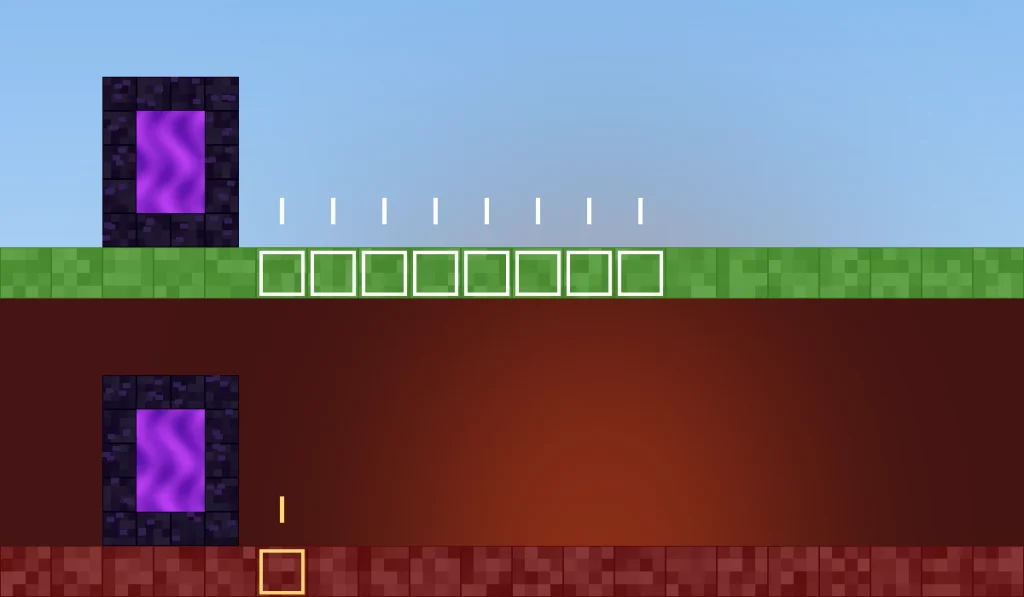
Every block you travel in the Nether equals 8 blocks in the Overworld (only the X and Z coordinates, not height). That’s why the Nether makes such a great fast-travel network. Walk 100 blocks in the Nether and you’ve covered 800 blocks back home.
It’s also why portals sometimes link to the wrong spot. When you walk through, the game divides your Overworld X and Z by 8 and looks for a portal near that point. If it can’t find one, it builds a new one. To link two portals on purpose, build the Nether-side portal at your Overworld coordinates divided by 8. For example, an Overworld portal at X 800, Z -240 should match a Nether portal at X 100, Z -30.
To see your coordinates, press F3 on Java Edition (Fn + F3 on many laptops). On Bedrock, turn on Show Coordinates in your world settings.
What to Pack Before You Step Through
The Nether is far more dangerous than the Overworld, so don’t go in with an empty inventory. Here’s what I pack every first trip:
- Full iron armor (or better), with at least one piece of gold armor. Piglins leave you alone if you wear gold.
- A spare flint and steel. Ghast fireballs can blow out your portal, and you’ll need to relight it to get home.
- A stack of cobblestone. It holds up to ghast blasts and lets you bridge over lava.
- Plenty of cooked food and a Fire Resistance potion if you have one.
- No bed for sleeping. Beds explode when used in the Nether.
For full mechanics and edge cases, the community-run Minecraft Wiki Nether portal page is the most detailed reference, and the official Minecraft.net site covers the latest game updates and patch notes.
Your Next Move
Gather 10 obsidian, craft a flint and steel, and build the 4×5 frame close to your base. Before you step through, write down your Overworld coordinates so you can find your way back. If you’re still learning the basics, start with our Minecraft beginner’s guide, and if your kids play on Xbox, see how to set up parental controls on Xbox.
Frequently Asked Questions
How many obsidian do you need for a Nether portal?
You need at least 10 obsidian to make a Nether portal in Minecraft. A complete 4×5 frame uses 14 blocks, but the four corner blocks are optional, so you can skip them and the portal still works. Larger portals need more obsidian, up to the maximum frame size of 23×23 blocks.
Can you make a Nether portal without a diamond pickaxe?
Yes. Build a mold out of dirt or cobblestone, pour lava where each obsidian block should go, then pour water over it so the lava turns into obsidian in place. This casting method only needs a water bucket and a lava bucket. You can also repair a ruined portal found in the Overworld.
Can you light a Nether portal without flint and steel?
Yes. A fire charge lights a Nether portal the same way flint and steel does, and fire charges often show up in ruined portal chests. Fire spreading from nearby lava can also ignite the frame, but it’s unpredictable and can burn your base. For most players, flint and steel is the simplest choice.
Why won’t my Nether portal light?
Your Nether portal usually won’t light because the frame has a gap, uses crying obsidian, or has something inside the opening, like tall grass or a torch. The frame must also stand upright and leave an opening between 2×3 and 21×21 blocks. Nether portals also won’t activate in the End dimension.
Can you build a Nether portal in the Nether?
Yes. A Nether portal built and lit inside the Nether takes you back to the Overworld. Players often build one at a specific spot so it links to a matching Overworld portal. Divide your Overworld X and Z coordinates by 8 to find the right location, since one Nether block equals eight Overworld blocks.