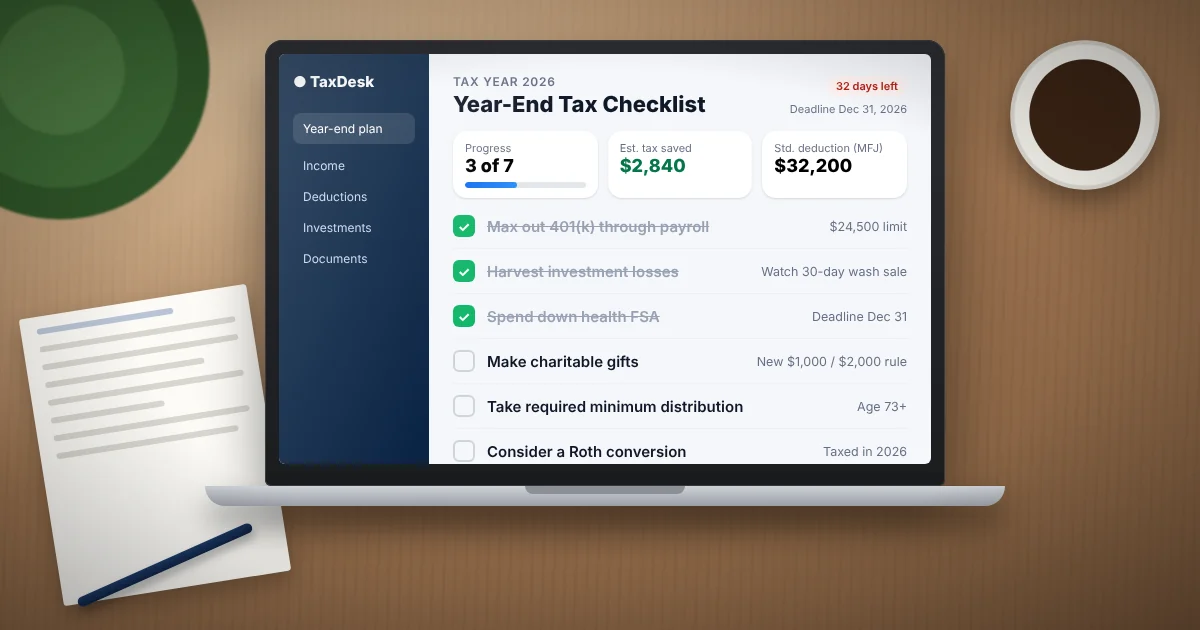
You have about 32 days left to make year-end tax moves that count on your 2026 return. The biggest wins for most Americans are simple: raise your 401(k) contribution for the last few paychecks, harvest investment losses, spend your health FSA, and time your charitable gifts under the new 2026 rules.
This year is different from last year. The One Big Beautiful Bill Act (OBBBA) changed charitable deductions, raised the SALT cap, and added new breaks for tips, overtime, car loan interest, and seniors. That means the year-end tax moves that worked in 2025 won’t all work the same way now. Below is the full checklist, with the 2026 numbers from the IRS and what to do before the deadline.
Key Takeaways
- Most year-end tax moves must be done by December 31, 2026, including 401(k) payroll contributions, loss harvesting, RMDs, and Roth conversions.
- The 2026 401(k) limit is $24,500, and the IRA limit is $7,500 (IRA and HSA deposits can wait until April 15, 2027).
- New in 2026: non-itemizers can deduct up to $1,000 in cash gifts to charity ($2,000 for joint filers).
- Itemizers now face a 0.5% of AGI floor on charitable gifts, so bunching donations matters more.
- Know your adjusted gross income first. It drives almost every phase-out in 2026.
Start Here: Know Your 2026 Numbers Before Making Year-End Tax Moves
Before you move a single dollar, pull your last pay stub and your brokerage tax center. You want a rough estimate of your 2026 adjusted gross income (AGI). Every smart year-end tax move starts there, because AGI decides your charitable floor, your SALT cap, and whether you qualify for the new deductions.
Here are the 2026 figures you’ll use most, based on the IRS tax year 2026 inflation adjustments and the IRS 2026 retirement plan limits.
| 2026 Item | Amount |
|---|---|
| Standard deduction (single / married filing jointly / head of household) | $16,100 / $32,200 / $24,150 |
| 401(k), 403(b), 457, TSP employee limit | $24,500 |
| 401(k) catch-up, age 50+ (ages 60 to 63) | $8,000 ($11,250) |
| IRA limit (catch-up age 50+) | $7,500 (+$1,100) |
| HSA limit (self-only / family), +$1,000 at 55+ | $4,400 / $8,750 |
| Health FSA limit (max carryover, if your plan allows) | $3,400 ($680) |
| SALT deduction cap | $40,400 |
| Annual gift tax exclusion, per person | $19,000 |
| QCD limit from an IRA (age 70½+) | $111,000 |
The 2026 Year-End Tax Checklist
Work through these year-end tax moves in order. The first few items have hard December 31 deadlines, so do those first.
1. Max Out Your 401(k) Through Payroll
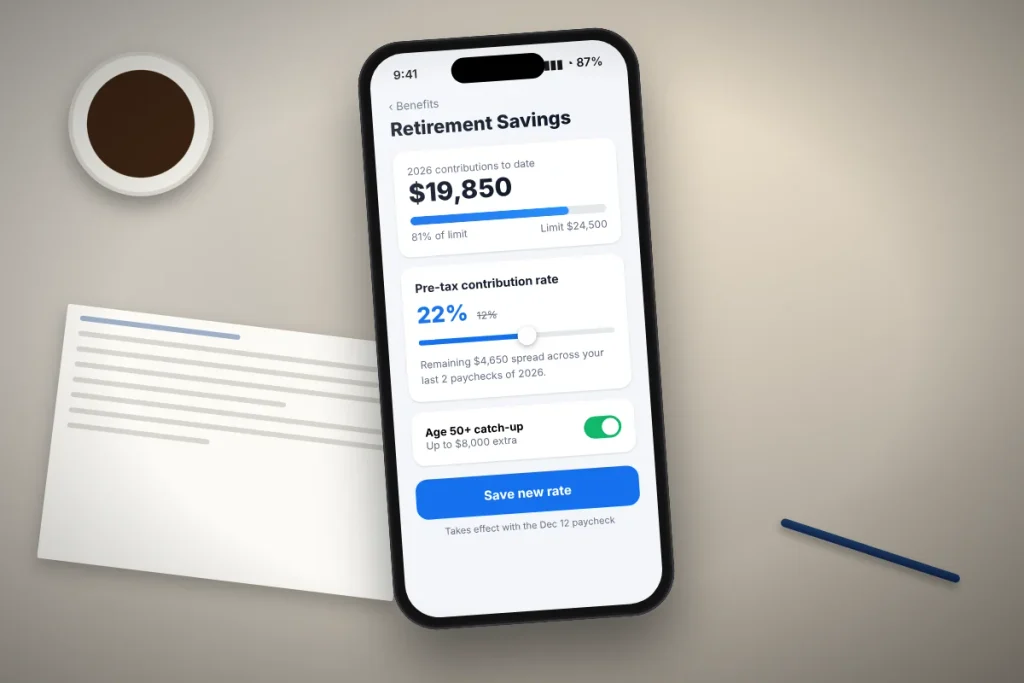
Of all the year-end tax moves on this list, this one has the hardest deadline. Your 401(k) contributions have to come out of a 2026 paycheck. You can’t write a check in January and count it for 2026. So log in to your benefits portal now and raise your contribution percentage for your last two or three paychecks.
Here’s a practical tip from doing this every year: many payroll systems need a week or more to process a change. If your last paycheck lands around December 19, a change made on December 15 might miss it. Also check if your employer match is “per paycheck.” If it is, maxing out too early can cost you match dollars, so ask HR before you front-load.
If you’re 50 or older, add the $8,000 catch-up. If you’re between 60 and 63, your catch-up limit is $11,250, so you could put up to $35,750 into the plan this year.
2. Plan Your IRA and HSA Contributions (You Have Until April)
Traditional and Roth IRA contributions for 2026 can be made up to the filing deadline, April 15, 2027. The same goes for HSA contributions. That makes them flexible year-end tax moves, but don’t wait if you already know you’ll contribute. Money invested in January has an extra three months to grow.
For the HSA, you need a qualifying high-deductible health plan. In 2026, that means a deductible of at least $1,700 for self-only coverage or $3,400 for family coverage.
3. Harvest Investment Losses
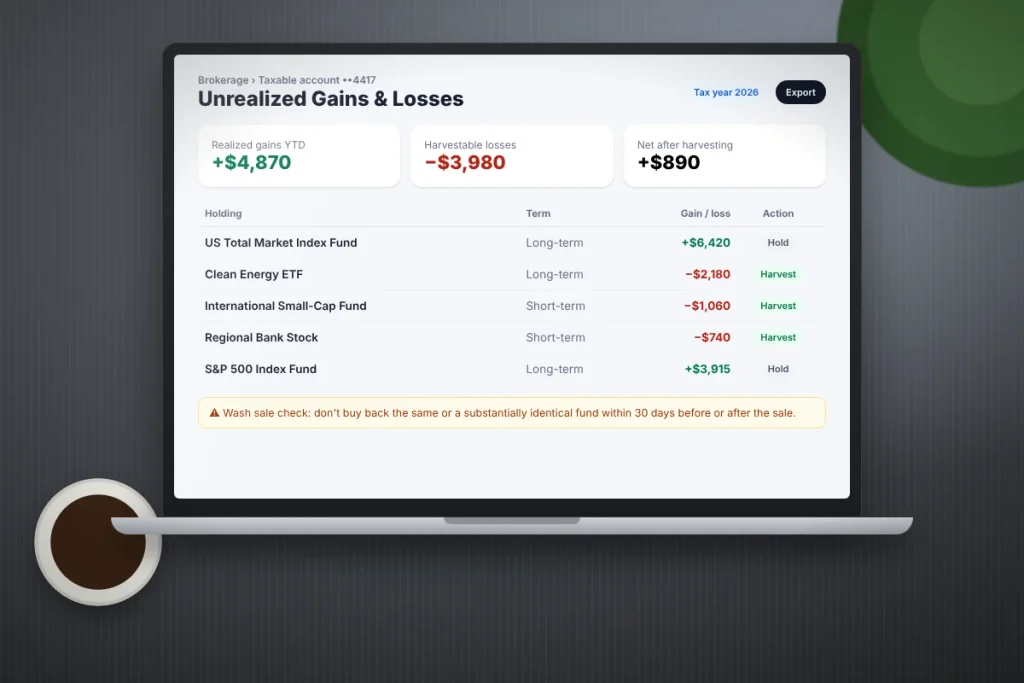
Tax-loss harvesting is one of the most useful year-end tax moves for anyone with a taxable brokerage account. You sell investments that are down, then use those losses to cancel out gains. If losses are bigger than gains, you can deduct up to $3,000 against ordinary income and carry the rest forward to future years.
Watch the wash sale rule. If you buy the same or a “substantially identical” investment within 30 days before or after the sale, the loss is disallowed. A common workaround is swapping one index fund for a similar but not identical one, like moving from an S&P 500 fund to a total market fund. Trades must settle under the 2026 tax year, so don’t leave this for December 31 at 3 p.m.
4. Use the 0% Capital Gains Bracket If You Qualify
This is the opposite of loss harvesting, and it’s one of the year-end tax moves plenty of people miss. In 2026, long-term capital gains are taxed at 0% if your taxable income stays under $49,450 (single) or $98,900 (married filing jointly). If you’re retired early, between jobs, or had a low-income year, you can sell winners and reset your cost basis at no federal tax cost.
Your state may still tax the gain, though. California, for example, taxes capital gains as regular income.
5. Spend Down Your Health FSA
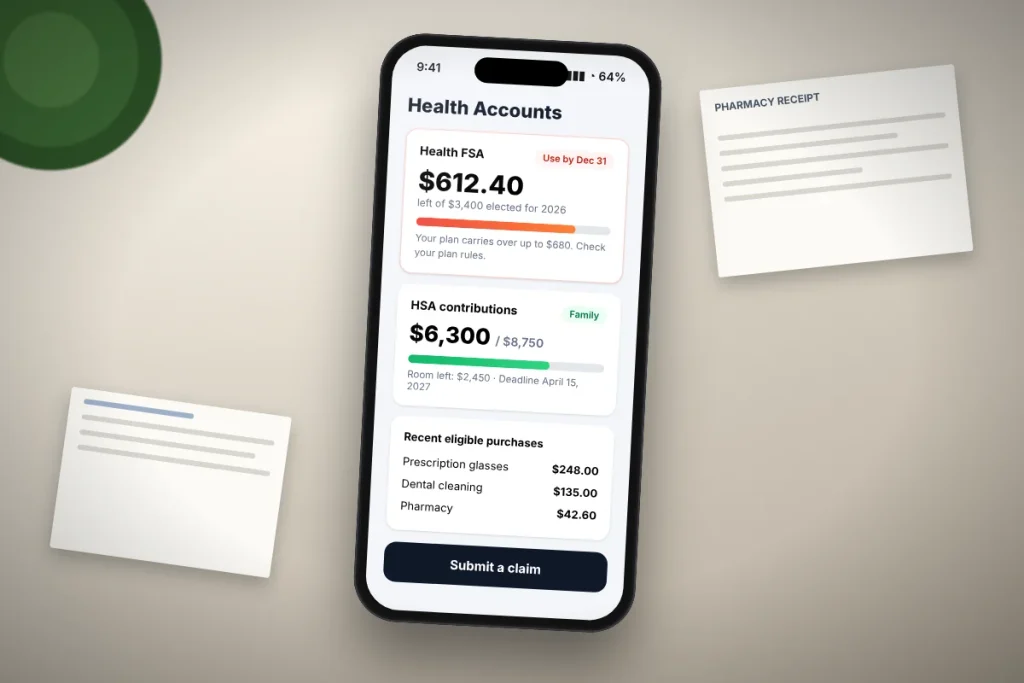
Health FSA money is mostly “use it or lose it.” Some plans let you carry over up to $680 into 2027, and others offer a grace period of up to two and a half months. Many offer neither. Check your plan rules this week, because this is one of the few year-end tax moves where you can lose real money by doing nothing.
If you have money left, book the eye exam, refill prescriptions, or buy eligible items like prescription glasses, contact lenses, or a first aid kit. Save every receipt.
6. Rethink Charitable Giving Under the New 2026 Rules
Charitable giving changed in two opposite directions this year, so your year-end tax moves here depend on whether you itemize.
- If you take the standard deduction: you can now deduct up to $1,000 in cash gifts to qualifying charities ($2,000 if married filing jointly). Donated goods like clothes don’t count, and gifts to donor-advised funds don’t qualify for this one.
- If you itemize: only the part of your gifts above 0.5% of your AGI is deductible. With a $200,000 AGI, the first $1,000 you give gets no deduction.
For itemizers, “bunching” makes more sense now. Instead of giving $5,000 a year, you might give $15,000 every third year (often through a donor-advised fund) so you clear the floor and beat the standard deduction in that year. Top-bracket taxpayers should also know the OBBBA caps the value of itemized deductions at 35 cents per dollar.
7. Take a Qualified Charitable Distribution If You’re 70½ or Older
A qualified charitable distribution (QCD) sends money straight from your IRA to a charity. For retirees, it’s one of the cleanest year-end tax moves available. It isn’t counted as income, it can satisfy your required minimum distribution, and it isn’t affected by the new 0.5% floor. The 2026 limit is $111,000 per person. Ask your IRA custodian to send it directly to the charity before December 31, since a check made out to you won’t qualify.
8. Take Your Required Minimum Distribution
If you’re 73 or older, your 2026 RMD must come out by December 31. (Your very first RMD can wait until April 1 of the next year, but then you’ll take two in one year.) Missing it triggers a 25% excise tax, cut to 10% if you fix it quickly. Inherited IRAs have their own rules, so check those separately.
9. Consider a Roth Conversion
Converting part of a traditional IRA to a Roth means paying tax now so future growth comes out tax-free. Among year-end tax moves, a Roth conversion is the one that raises your tax bill now on purpose. It counts in the year it happens, so it must be done by December 31 to land on your 2026 return. The best time is a lower-income year. A common approach is converting just enough to “fill up” your current bracket. For 2026, the 22% bracket ends at $105,700 of taxable income for single filers and $211,400 for joint filers.
Be careful near thresholds. A conversion raises your AGI, which can shrink the new senior deduction, the SALT cap, and other breaks. If you’re on Medicare, it can also raise your premiums two years later.
10. Check Your SALT Deduction and Timing
The state and local tax (SALT) cap jumped to $40,400 for 2026. That’s a big change if you live in a high-tax state like New Jersey or New York. Once your modified AGI passes $505,000, the cap starts shrinking, but it never drops below $10,000.
If you’re close to itemizing, you may be able to pay your January property tax bill in December, as long as it has been assessed. Run the numbers first, as with all year-end tax moves. Paying early only helps if itemizing beats your standard deduction.
11. Claim the New OBBBA Deductions
Four newer deductions run from 2025 through 2028, and you can take them whether or not you itemize. They’re claimed on the new Schedule 1-A.
- Tips: up to $25,000 of qualified tips, for workers in occupations on the Treasury list.
- Overtime: up to $12,500 of the “extra” half of overtime pay ($25,000 joint).
- Car loan interest: up to $10,000 of interest on a loan for a new, US-assembled personal vehicle.
- Seniors 65+: an extra $6,000 per person ($12,000 if both spouses qualify).
All four phase out at higher incomes. Your year-end move here is record-keeping: compare your last pay stub to your own logs of tips and overtime, and keep your car loan statement.
12. Pay Estimated Taxes and Make Gifts Before the Year Ends
If you’re self-employed or had big investment income, the fourth-quarter estimated payment is due January 15, 2027. You can pay through IRS Direct Pay. If you’re a W-2 employee who owes, raising withholding on your final paychecks can help you avoid an underpayment penalty, because withholding is treated as paid evenly through the year.
Gifting is one of the simplest year-end tax moves for families, and it runs on a calendar-year clock. You can give up to $19,000 per person in 2026 without filing a gift tax return. Parents can also contribute up to $5,000 a year to a child’s Trump Account, which began taking deposits on July 4, 2026. For 529 plans, check your state: New York, for example, lets residents deduct up to $5,000 ($10,000 joint) in contributions on their state return.
Year-End Tax Moves Deadline Cheat Sheet
| Deadline | Year-end tax moves due |
|---|---|
| December 31, 2026 | 401(k) payroll deferrals, loss harvesting trades, RMDs, QCDs, Roth conversions, charitable gifts, FSA spending (most plans), annual gifts |
| January 15, 2027 | Q4 2026 estimated tax payment |
| April 15, 2027 | 2026 IRA and HSA contributions, 2026 tax return |
Common Mistakes to Avoid With Year-End Tax Moves
- Triggering a wash sale in an IRA or a spouse’s account. The rule applies across your household’s accounts.
- Donating to itemize when you won’t itemize. With a $32,200 standard deduction for couples, many people are better off with the new $2,000 cash deduction.
- Waiting until the last week. Brokerages, payroll teams, and charities get swamped in late December.
- Ignoring state rules. Federal year-end tax moves can play out differently on your state return.
If you’re changing jobs, a 401(k) rollover might also be on your list. Our guide on how to roll over a 401(k) to an IRA walks through it. If you’ve moved this year, see how to change your address with the IRS and SSA so your tax forms reach you. Investors choosing what to buy after harvesting losses can read index funds vs individual stocks.
This article is for general information and isn’t tax or legal advice. Your situation may differ, so check with a CPA or enrolled agent before making big decisions.
Frequently Asked Questions
What should I do before December 31 to lower my taxes?
The most effective year-end tax moves are raising 401(k) payroll contributions, selling losing investments to offset gains, spending leftover FSA money, and making charitable gifts. If you’re 73 or older, take your RMD. Roth conversions and charitable gifts also must happen by December 31 to count for 2026.
Can I still contribute to an IRA for 2026 after December 31?
Yes. You can make 2026 traditional or Roth IRA contributions until the tax filing deadline, April 15, 2027. The 2026 limit is $7,500, plus a $1,100 catch-up if you’re 50 or older. HSA contributions follow the same April deadline. 401(k) contributions, however, must come out of a 2026 paycheck.
Can I deduct charitable donations if I don’t itemize in 2026?
Yes, starting in 2026. If you take the standard deduction, you can deduct up to $1,000 of cash donations to qualifying charities, or $2,000 if married filing jointly. Non-cash donations like clothing and gifts to donor-advised funds don’t qualify for this deduction. Keep a receipt or bank record for every gift.
How much can I lose in the stock market and deduct on taxes?
Capital losses first offset your capital gains with no limit. If losses exceed gains, you can deduct up to $3,000 a year against ordinary income ($1,500 if married filing separately). Any unused loss carries forward to future tax years indefinitely. Avoid buying back a substantially identical investment within 30 days.
Is it better to pay property taxes in December or January?
Paying in December only helps if you itemize deductions in 2026 and your SALT total is under the $40,400 cap. The tax must already be assessed, and prepaying won’t help if you take the standard deduction. Compare your total itemized deductions against your standard deduction before you pay early.
When is the fourth-quarter estimated tax payment due for 2026?
The fourth-quarter estimated tax payment for tax year 2026 is due January 15, 2027. You can pay online through IRS Direct Pay or your IRS online account. W-2 employees who owe can raise withholding on their last paychecks instead, since withholding counts as if it were paid evenly through the year.
Your Next Step
Block 30 minutes this week. Pull your latest pay stub, your brokerage’s gains and losses page, and your FSA balance. Then knock out the December 31 items first: your 401(k) change, loss harvesting, and any RMD or charitable gift. Those three or four year-end tax moves usually deliver most of the savings. Once that’s done, watch for your W-2 and 1099s in January, and use our guide to check your tax refund status with the IRS after you file.