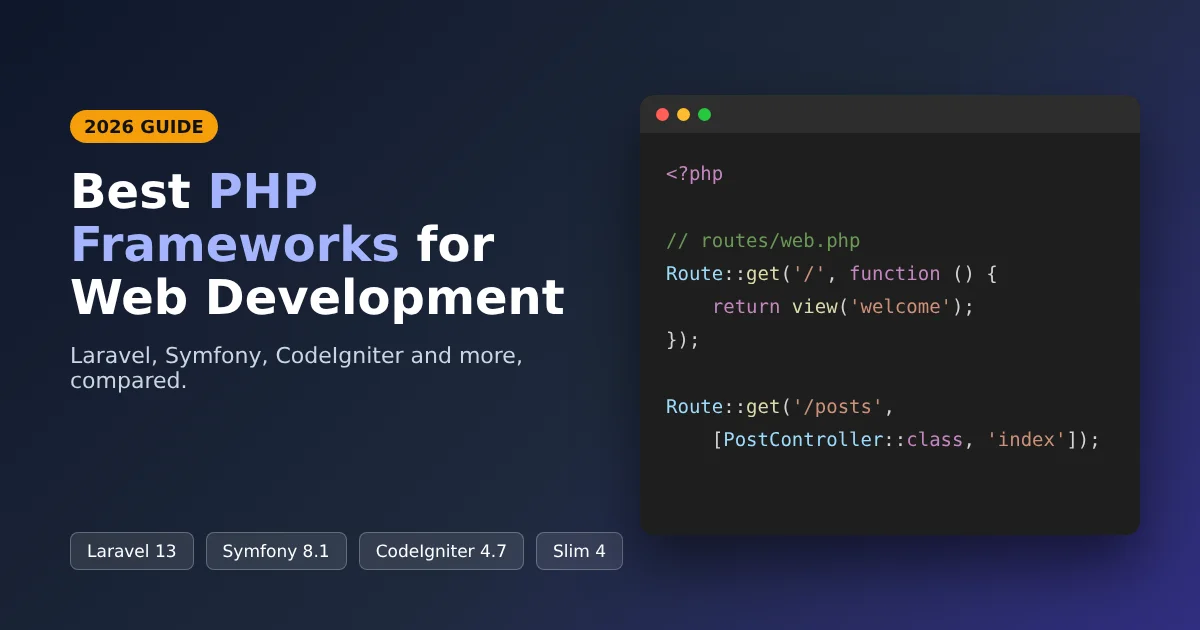
The best PHP frameworks for web development in 2026 are Laravel, Symfony, CodeIgniter, CakePHP, Yii 3 and Slim. For most new projects, Laravel is the safest pick. It has the biggest community, the most tutorials, and built-in tools for logins, queues, email and testing.
Choose Symfony for large business apps that need to run for years, and reach for CodeIgniter or Slim when you want something small and fast on cheap hosting. Below, you’ll find what each framework does well, where it falls short, the PHP version it needs, and the exact command to start a project.
PHP isn’t going anywhere, either. According to W3Techs, PHP runs about 70% of all websites whose server-side language is known, far ahead of JavaScript, Ruby and Java.
Key Takeaways
- Laravel 13 is the best all-around pick for new web apps and needs PHP 8.3 or newer.
- Symfony 7.4 LTS gets security fixes until November 2029, ideal for long-term business projects.
- CodeIgniter 4 and Slim 4 are the lightest options for small sites and APIs.
- Check your host’s PHP version first. PHP 8.2 loses security support on December 31, 2026.
How We Picked the Best PHP Frameworks for Web Development
We didn’t rank these by hype. Every PHP framework on this list had to pass a few practical tests that matter when you’re the one maintaining the code at 11 p.m. on a Friday.
- Active maintenance: regular releases and a published support schedule.
- Modern PHP support: runs on PHP 8.2 or newer, which is what current hosting plans offer.
- Community and jobs: enough tutorials, packages and job listings that you won’t get stuck alone.
- Real-world fit: it has to solve a clear type of project better than the others.
PHP Frameworks Compared at a Glance
Here’s the short version. Versions and PHP requirements are current as of October 31, 2026, based on each project’s official release pages.
| Framework | Current Version | Minimum PHP | Best For | Learning Curve |
|---|---|---|---|---|
| Laravel | 13.x | 8.3 | Full web apps, SaaS, startups | Easy to moderate |
| Symfony | 8.1 (7.4 LTS) | 8.4 (8.2 for 7.4) | Enterprise and long-term apps | Moderate to steep |
| CodeIgniter | 4.7 | 8.2 | Small sites, beginners, shared hosting | Easy |
| CakePHP | 5.3 | 8.2 | CRUD apps and admin panels | Moderate |
| Yii | 3 | 8.2 | PSR-based, package-driven projects | Moderate to steep |
| Slim | 4.x | 7.4 (use 8.3+) | REST APIs and microservices | Easy |
1. Laravel: The Best PHP Framework for Most Projects
Laravel is the default choice among PHP frameworks for a reason. In the JetBrains State of PHP 2025 survey, 64% of PHP developers said they use it, far more than any other framework. That popularity pays off every time you search for an error message and find an answer in seconds.
Laravel 13 shipped on March 17, 2026. It requires PHP 8.3, adds optional PHP attributes for configuring models and jobs, and includes a first-party AI SDK for text generation, embeddings and vector search. Under Laravel’s official support policy, version 13 gets bug fixes through Q3 2027 and security fixes through Q1 2028.
Why developers like it
- Eloquent ORM makes database work readable, even for beginners.
- Starter kits give you login, registration and password reset in minutes.
- Queues, scheduling, mail and caching are built in, not bolted on.
- Deployment tools like Laravel Forge and Laravel Cloud handle servers for you.
Watch out for
Laravel uses a lot of “magic” (facades, auto-loaded helpers), which can hide what’s happening under the hood. It’s also heavier than a micro-framework, so it’s overkill for a five-page brochure site. One practical tip: if your web host is still stuck on PHP 8.2, stay on Laravel 12. It gets security fixes until February 24, 2027, which buys you time to upgrade.
composer create-project laravel/laravel my-app
cd my-app
php artisan serve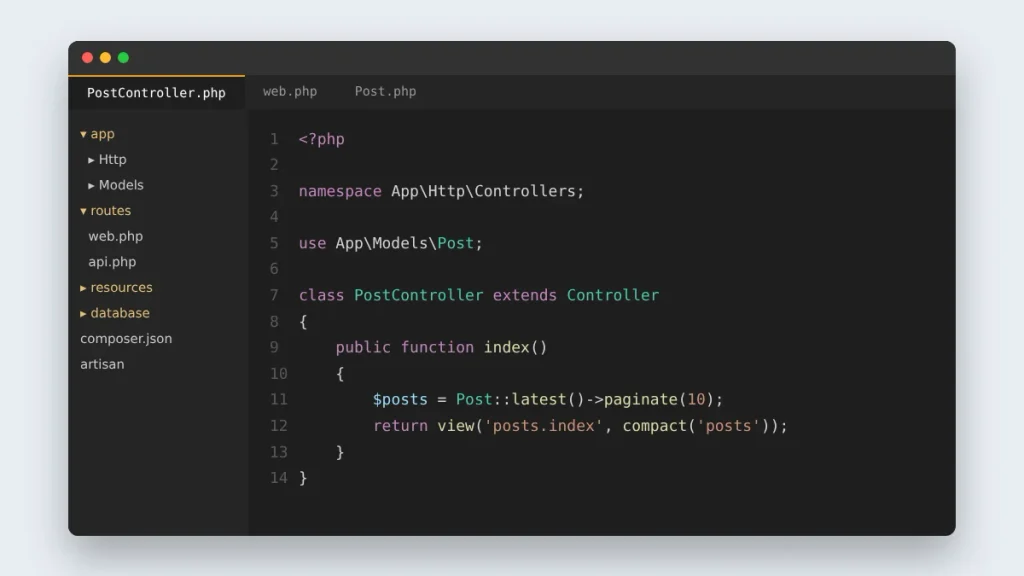
Ready to put a Laravel site online? Our guide on how to deploy a Laravel website on cPanel walks through it step by step.
2. Symfony: Best PHP Framework for Enterprise Projects
Symfony is the PHP framework other frameworks are built on. Laravel itself ships with Symfony components like HttpFoundation, Routing and Console, and Drupal relies on them too. If you’ve used PHP in the last decade, you’ve probably run Symfony code without knowing it.
Symfony releases a new minor version every May and November. Symfony 8.1 came out on May 29, 2026, and requires PHP 8.4. The big deal for businesses is the long-term support (LTS) track: according to the official Symfony release schedule, Symfony 7.4 LTS gets bug fixes until November 2028 and security fixes until November 2029.
When Symfony makes sense
- You’re building something a team will maintain for five years or more.
- You want strict structure, dependency injection and clear separation of code.
- Your app has complex rules, like a banking portal, an insurance quoting tool or a large e-commerce backend.
My honest take: Symfony asks more of you up front. The configuration, service container and bundle system take a few weeks to feel natural. But once a project grows past 50,000 lines of code, that structure is what keeps it from turning into a mess. For long-lived client work, pin the LTS version and upgrade on your schedule, not the framework’s.
composer create-project symfony/skeleton my_project
cd my_project
composer require webapp
3. CodeIgniter 4: The Best PHP Framework for Beginners
CodeIgniter is the lightweight PHP framework I recommend to anyone writing their first MVC app. The download is small, configuration is minimal, and it runs happily on a $3 to $10 a month shared hosting plan from a US host like Bluehost or Hostinger, as long as the plan offers PHP 8.2 or newer.
The 4.7 branch is current, with 4.7.0 released in February 2026 and steady patch releases since. For security, the app’s entry file lives in the public folder rather than the project root, so point your domain’s document root there.
- Pros: fast, easy to learn, clear documentation, few moving parts.
- Cons: smaller package ecosystem than Laravel, fewer built-in features for big apps.
composer create-project codeigniter4/appstarter my-app
cd my-app
php spark serve
4. CakePHP 5: Best PHP MVC Framework for CRUD Apps
CakePHP follows “convention over configuration.” Name your database tables and classes the way Cake expects, and it wires everything together for you. Its bake command can generate models, controllers and templates for a full create, read, update and delete (CRUD) interface in seconds.
CakePHP 5.3 was released on January 10, 2026, and requires PHP 8.2. It added rate-limiting middleware, Redis cluster support and better pagination tools. It’s a strong fit for internal business tools, like an inventory tracker for a warehouse in Ohio or a booking system for a local clinic.
composer create-project --prefer-dist cakephp/app:~5.0 my_app
cd my_app
bin/cake server
5. Yii 3: Best PHP Framework for Package-Based Projects
Yii 3 had its official stable release on December 31, 2025, after years of development. It’s a big change from Yii 2. Instead of one giant framework, Yii 3 is a set of independent packages built on PHP standards (PSR-7, PSR-11, PSR-15), so you can mix in Symfony or other Composer packages without fighting the framework.
It requires PHP 8.2 or newer. The tradeoff is a smaller US job market and fewer tutorials than Laravel. If you maintain an older Yii 2 app, there’s no rush, but plan new projects on Yii 3.
6. Slim 4: Best Lightweight PHP Framework for APIs
Slim gives you routing, middleware and PSR-7 request and response objects, and that’s about it. You choose your own database layer, templates and validation. That makes it perfect for a small REST API, a webhook receiver or a backend for a mobile app.
<?php
use Psr\Http\Message\ResponseInterface as Response;
use Psr\Http\Message\ServerRequestInterface as Request;
use Slim\Factory\AppFactory;

require __DIR__ . '/vendor/autoload.php';

$app = AppFactory::create();

$app->get('/hello/{name}', function (Request $request, Response $response, array $args) {
    $response->getBody()->write("Hello, " . $args['name']);
    return $response;
});

$app->run();
Install it with composer require slim/slim:”4.*” slim/psr7, then drop the file above into your public folder.
Laravel vs Symfony: Which PHP Framework Should You Choose?
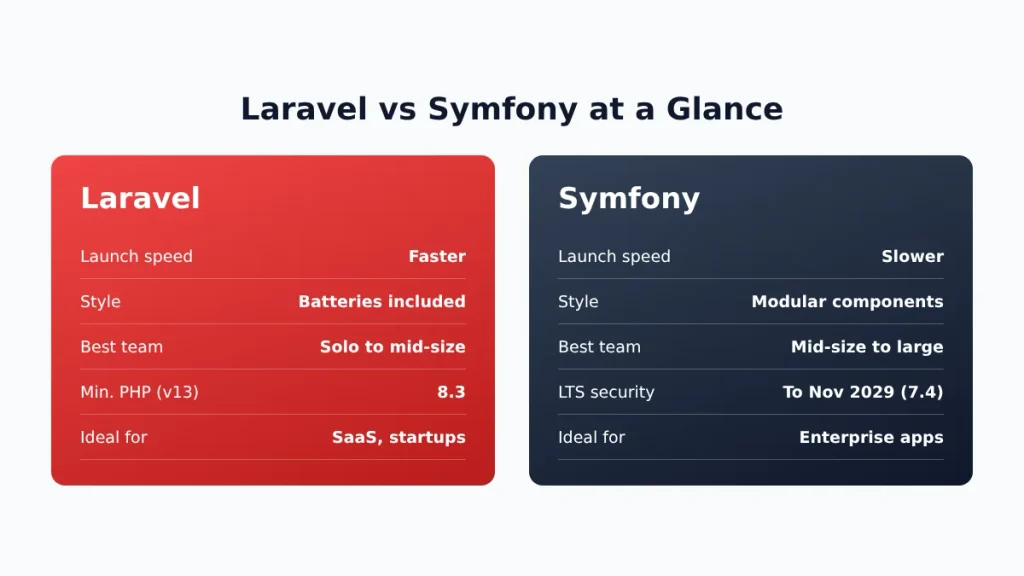
This is the question we hear most. Both are excellent PHP frameworks, so the answer depends on your team and timeline, not on which one is “better.”
| Factor | Laravel | Symfony |
|---|---|---|
| Speed to first launch | Faster | Slower |
| Long-term support | About 2 years of security fixes | LTS with up to 4 years of security fixes |
| Flexibility | Opinionated, batteries included | Highly modular |
| Best team size | Solo devs to mid-size teams | Mid-size to large teams |
Go with Laravel if you’re a freelancer, a startup or a small agency that needs to ship fast. Go with Symfony if you’re building for a large company with a strict upgrade policy and a long maintenance contract.
How to Choose the Best PHP Framework for Web Development
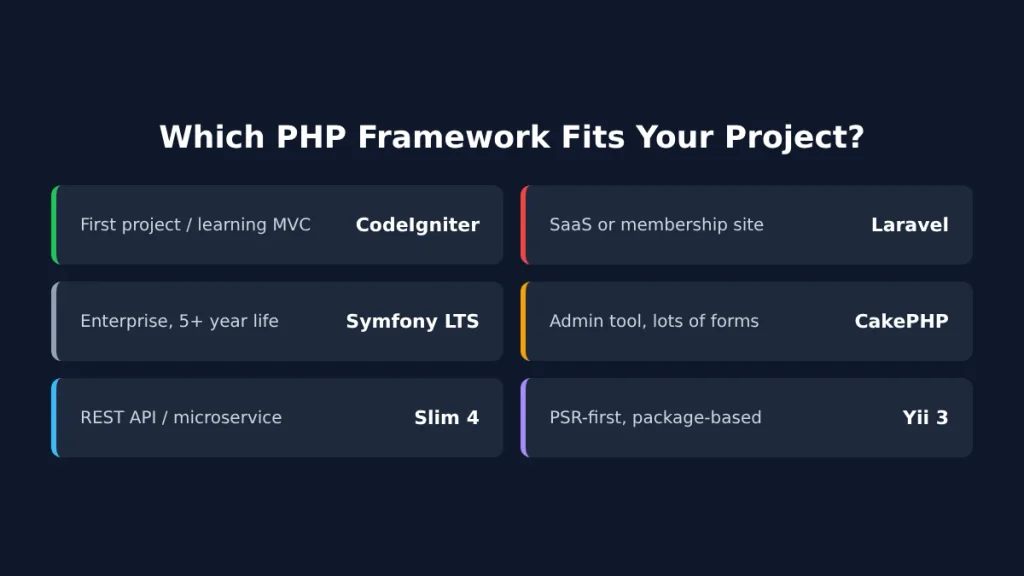
Match the PHP framework to the job, not the other way around. Use this quick guide:
- First project or learning MVC: CodeIgniter 4, then move to Laravel.
- SaaS, marketplace or membership site: Laravel.
- Enterprise app with a 5+ year life: Symfony LTS.
- Internal admin tool with lots of forms: CakePHP.
- Lightweight API or microservice: Slim 4.
- Content site or blog: you may not need a PHP framework at all. WordPress, which is also PHP, could be the faster route.
Check your PHP version before you pick
Your host’s PHP version can rule out a PHP framework before you write a line of code. Here’s the official support schedule from PHP.net:
| PHP Version | Active Support Ends | Security Support Ends |
|---|---|---|
| PHP 8.2 | December 31, 2024 | December 31, 2026 |
| PHP 8.3 | December 31, 2025 | December 31, 2027 |
| PHP 8.4 | December 31, 2026 | December 31, 2028 |
| PHP 8.5 | December 31, 2027 | December 31, 2029 |
For a new project starting today, use PHP 8.4 or 8.5. Most cPanel hosts let you switch versions in a couple of clicks under “Select PHP Version” or “MultiPHP Manager.”
You’ll also want a good editor. Our list of the best free code editors for developers covers VS Code and other options that work well with PHP. If you’re also weighing other languages, see our guide to the best Python libraries for web development.
Frequently Asked Questions
What is the best PHP framework for beginners?
CodeIgniter 4 is the easiest PHP framework for beginners. It has a small footprint, simple setup and clear documentation, and it runs on cheap shared hosting. Once you’re comfortable with MVC basics, move to Laravel, which has more features, a larger community and many more job openings in the United States.
Is Laravel better than Symfony?
Neither is better in every case. Laravel is faster to learn and quicker for launching apps, which suits startups and freelancers. Symfony is more modular and offers long-term support releases with up to four years of security fixes, which suits large enterprise projects. Laravel actually uses several Symfony components under the hood.
Is PHP still worth learning in 2026?
Yes. According to W3Techs, PHP runs about 70% of websites with a known server-side language, including every WordPress site. PHP 8.4 and 8.5 are fast and modern, and frameworks like Laravel and Symfony are actively developed. There’s steady demand for PHP developers, especially for Laravel and WordPress work.
Which PHP framework is the fastest?
Micro-frameworks like Slim and lightweight options like CodeIgniter have the least overhead, so they usually respond fastest out of the box. In real apps, speed depends more on caching, OPcache, database queries and server setup than on the framework. A well-tuned Laravel or Symfony app can handle heavy traffic easily.
Do I need a framework to build a PHP website?
No, but it helps for anything beyond a few pages. A framework gives you routing, database tools, form validation and built-in security against common attacks like SQL injection and cross-site scripting. For a simple blog, WordPress may be easier. For a custom web app, a framework saves weeks of work.
Your Next Step: Build One Small Project This Week
Reading comparisons only gets you so far. Pick the PHP framework that matches your project from the guide above, run the install command, and build something tiny, like a to-do list with a login page. You’ll know within a weekend whether it clicks.
If you’re still unsure, start with Laravel. It’s the most popular of the best PHP frameworks for web development, it has the most help online, and the skills carry over to almost any PHP job you’ll see posted in the US.